
What is Fiber Optic Cable ?
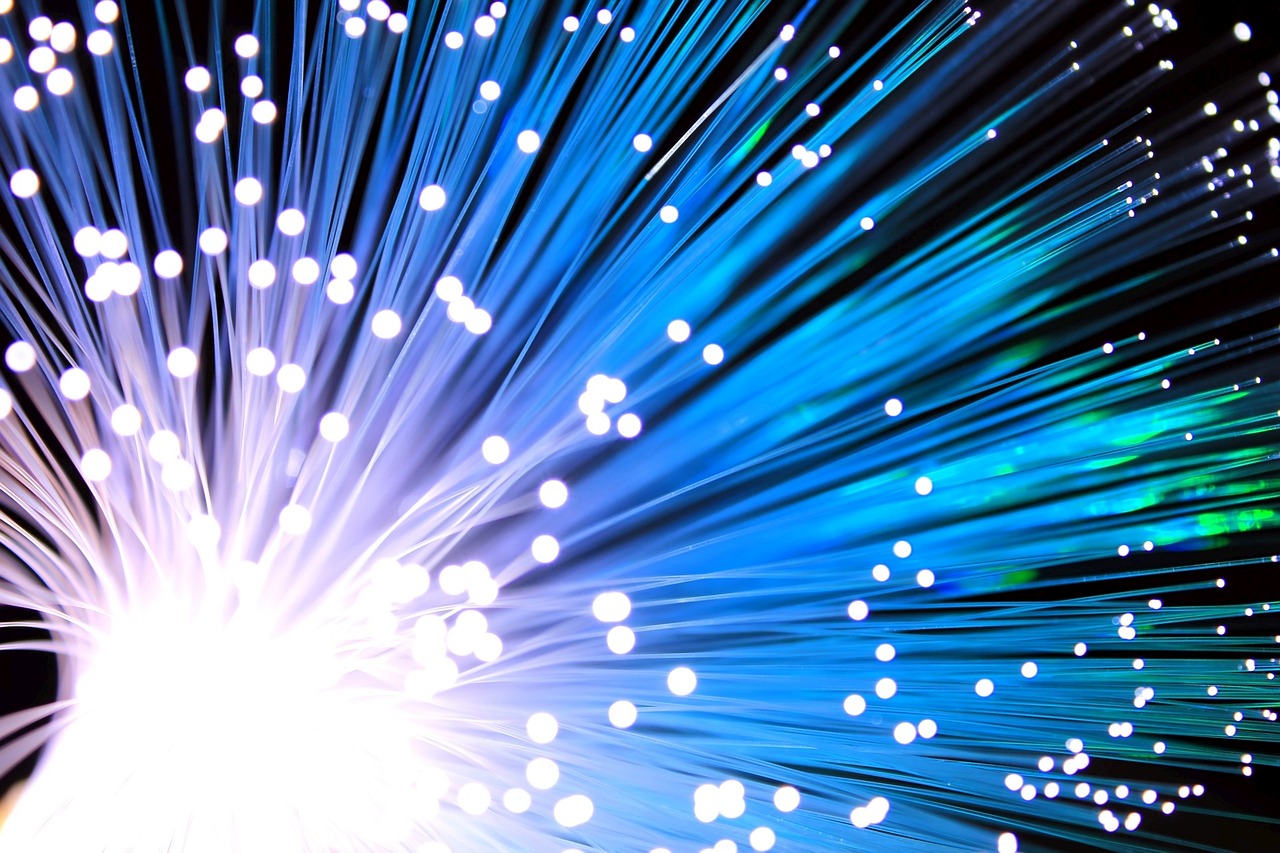
 Fiber optic cable is a cable that contains one or more optical fibers that are used to carry light. Fiber Cores are individually coated with a protective plastic layers in a protective tube which make fiber optic cable more safe & suitable for the all environment . Different types of fiber optic cable are used in different applications.
Type Of Fiber Optic Cables
Single Mode (SM)
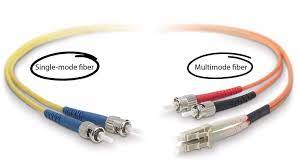
Single Mode (SM) fiber is used for longer distances & or higher bandwidth needs. Fiber optic cables carry signals using light & only carry one mode of light. Single-mode fiber optic cables are more resistant to attenuation.used for longer transmission distances, lower attenuation, and higher data transmission speeds.
Multi mode (MM)
• Multimode fiber optic cable is a cable that can carry multiple modes of light. This is in contrast to single-mode fiber optic cables, which can only carry one mode of light. Multimode fiber optic cables are typically used for short-distance communication applications.
Benefits of Fiber Optic Cable
- High bandwidth: Fiber optic cables can carry much more data & high-speed data transfer than traditional copper cables.
- Long distance: Fiber optic cables can transmit data for long distances nearly 20Km plus without losing signal strength.
- Security: Fiber optic cables are immune to electromagnetic interference & CrosTalk effects.
Area Of Use
Telecommunications: Fiber optic cables are used to transmit voice, data, and video signals over long distances.
• Internet access: Fiber optic cables are used to provide high-speed internet access to homes and businesses.
• Security systems: Fiber optic cables are used in security systems to transmit video and audio signals. They are immune to electromagnetic interference, which makes them a secure choice for security applications.
• Medical imaging: Fiber optic cables are used in medical imaging equipment,
Accessories used with Fibre Optic Network
Connectors: Pigtel is used to connect active equipment & to join two fibre optic cables together. Commonly used types of fibre optic connectors are:
- LC Connector
- SC Connector
- ST Connector
- FC Connector
- MTRJ Connector
- SMA Connector
- E2000 Connector
- MU Connector
Adapters: To join two connections, for example, to unite two cables with various connector types.
- LC
- SC
- ST
- FC
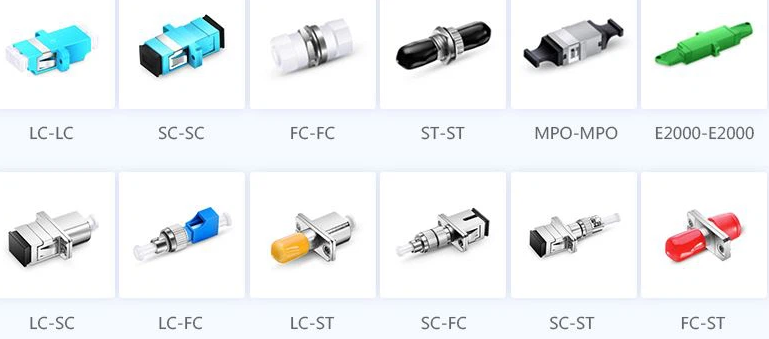
 Patch cords: short fibre optic cables with connections on both ends are known as patch cords &used to connect Active devices to a fibre optic network.
 Splice enclosures: used to protect fibre-optic splices and organise using splice enclosures or patch panels. They are available in different sizes and types for indoor and outdoor uses
Cable management tools: used to organise and safeguarded Fiber optic cables using cable management tools like strain relief boots and cable ties.
 Test tools: used to assess the performance of fibre optic cables and spot any problems or errors. Examples include power meters and OTDRs (Optical Time Domain Reflectometers).
Cleaning supplies: to make sure optimal performance, the connectors on fibre optic cables are cleaned using cleaning swabs and solutions.
How to Choose the Right Fiber Connector
In practice, almost every ELV, CCTV and LAN project uses one of four connector types. The choice depends mostly on the equipment and the port density you need.
- LC: a small push-latch connector, normally used as a duplex pair. Nearly all SFP and SFP+ modules have LC ports, so LC is the default for switch connections and high-density ODFs.
- SC: a larger square push-pull connector. Still common in ODFs, wall outlets and FTTH/GPON networks, where SC/APC is widely used.
- ST: a round bayonet-lock connector. Mostly found on older multimode installations and some industrial equipment.
- MPO/MTP: a multi-fiber connector, usually 12 or 24 fibers in one ferrule. Used for pre-terminated trunk cables in data centres and for 40G/100G parallel optics. MPO needs careful attention to polarity and to pin (male/female) gender.
Where possible, match the ODF connector to the equipment. An SC ODF feeding LC switch ports needs SC-LC hybrid patch cords. Every adapter and patch cord must match the fiber type and polish (UPC or APC).
Indoor, Outdoor and Armoured Cable
Indoor cable
Indoor cable is usually tight-buffered, flexible and easy to terminate. An LSZH (low smoke zero halogen) jacket is the usual choice for buildings; check the project specification for the required fire rating.
Outdoor cable
Outdoor cable is normally loose-tube, with gel or dry water-blocking material, a UV-resistant polyethylene jacket and a central strength member. It is designed for ducts and exposure to sunlight and temperature changes, which matters in hot climates like Saudi Arabia. Many projects transition to indoor cable at the building entry using a splice enclosure.
Armoured cable
Armoured cable adds a corrugated steel tape or steel wire layer for protection against crushing and rodents. It is the usual choice for direct burial, rough duct routes, perimeter CCTV and industrial sites. Metallic armour should be bonded and earthed as the specification requires. Where metal is not allowed, non-metallic (glass yarn or FRP) rodent-resistant cable is an alternative.
Worked Example: Link Loss Budget
A loss budget tells you, before installation, how much light the link should lose. This example uses commonly quoted typical values; use your project specification or datasheets for real designs.
Scenario: a 2 km OS2 single-mode link between two buildings, tested at 1310 nm. Each end has an ODF with fusion-spliced pigtails, so there are 2 mated connector pairs (one at each ODF) and 2 fusion splices.
| Item | Typical value | Quantity | Loss |
|---|---|---|---|
| OS2 fiber at 1310 nm | about 0.35 dB/km | 2 km | 0.70 dB |
| Mated connector pair | about 0.3 dB | 2 | 0.60 dB |
| Fusion splice | about 0.1 dB | 2 | 0.20 dB |
| Expected link loss | 1.50 dB |
Many designers add a margin, often around 3 dB, for ageing and future repairs, giving about 4.5 dB. Next, check the transceiver. Its power budget is its minimum transmit power minus its receiver sensitivity. For example, a module with a minimum transmit power of -8 dBm and a sensitivity of -14 dBm has a 6 dB budget, which comfortably covers this link. These module figures are only an illustration; use your actual datasheet.
Standards allow higher maximum values than these typical figures (TIA-568, for example, permits up to 0.75 dB per mated connector pair and 0.3 dB per splice), so for critical links it is worth checking the worst case as well. After installation, the measured end-to-end loss should be below your calculated figure.
Common Mistakes to Avoid
- Mixing APC and UPC. A green APC connector in a blue UPC adapter, or vice versa, causes high loss and can damage both end faces. Keep polish types consistent across patch cords, adapters and pigtails.
- Connecting without cleaning and inspecting. Inspect and clean before every connection, even new patch cords.
- Mixing fiber types. Single-mode with multimode, or 62.5 µm with 50 µm, should never be joined in one link.
- Bending too tightly. Follow the cable’s minimum bend radius, which is often quoted as about 10 times the cable diameter at rest and 20 times while pulling. Tight bends add loss.
- Wrong Tx/Rx polarity. On duplex links, transmit at one end must reach receive at the other. Label cores clearly.
FAQ
Which connector should I choose for a new CCTV fiber backbone?
LC duplex UPC is the most common choice because it matches SFP modules directly and allows high port density in the ODF. Use SC/APC only if the network is GPON-based or the equipment requires it.
Do I always need armoured cable outdoors?
Not always. In a protected duct system, standard outdoor loose-tube cable is often enough. Armoured cable is recommended for direct burial, routes with rodent risk, or anywhere the cable may be crushed.
What is a good loss result for a short fiber link?
There is no single number. A good result is one that is below the calculated loss budget for that specific link, based on its length, connectors and splices. For a short single-mode link with two connector pairs and two splices, around 1 dB at 1310 nm is common.
Can I use a mechanical splice instead of fusion splicing?
Mechanical splices suit quick repairs, but usually have higher loss and reflection than fusion splices. For permanent backbones, fusion splicing is normal practice.
Related tools
Designing a fiber or CCTV network? Try our free Network & CCTV Designer to plan switches, fiber routes and camera connections in one place.

Pingback: Fiber Optic Network Terminology: Key Terms Explained - techubox.com