
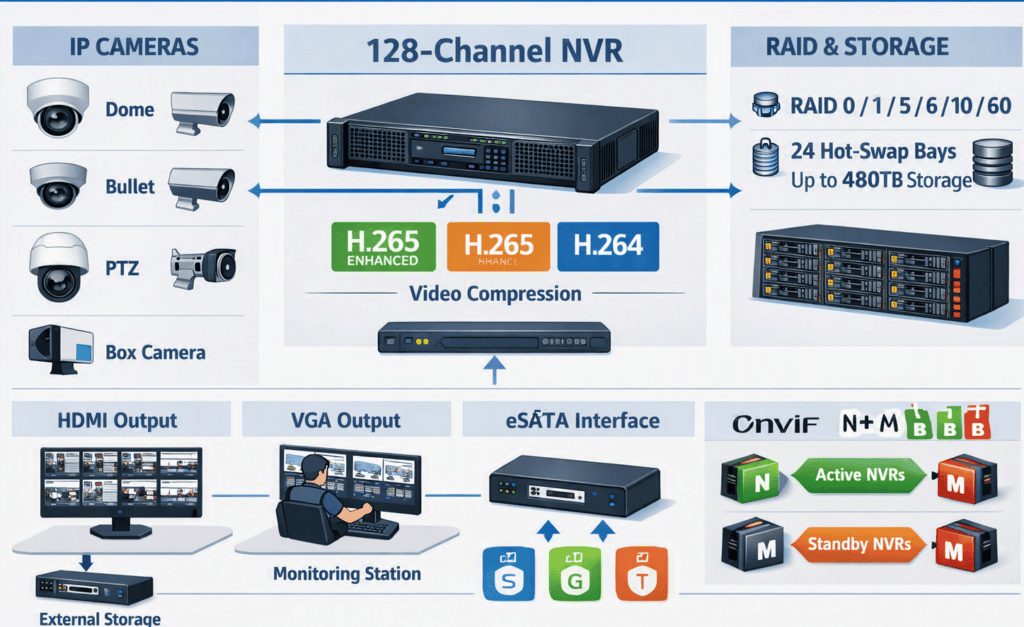
NVR The Powerhouse
The Powerhouse Behind Modern Surveillance
In today’s world of large‑scale surveillance — airports, universities, industrial plants, smart cities — the backbone of every reliable security system is a high‑capacity Network Video Recorder (NVR). Among these, the 128‑Channel Embedded NVR stands out as a true workhorse engineered for massive deployments, uninterrupted recording, and intelligent video management.
This blog breaks down its architecture, features, and real‑world applications with clear explanations and illustrative diagrams.
Like this Feature In NVR
- 128 Channel input.
- Support Enhanced (H.265, H.264), H.264, H.264 Video Format.
- 24 SATA Hot Swappable HDDs Bays.
- HDMI and VGA simultaneous output.
- Support RAID (0/1/5/6/10/50/60).
- eSATA Interface.
- ONVIF Profile (S, G, T).
- N+M Hot Standby.
🧠 1. High‑Density Video Input: 128 Channels of Pure Surveillance Power
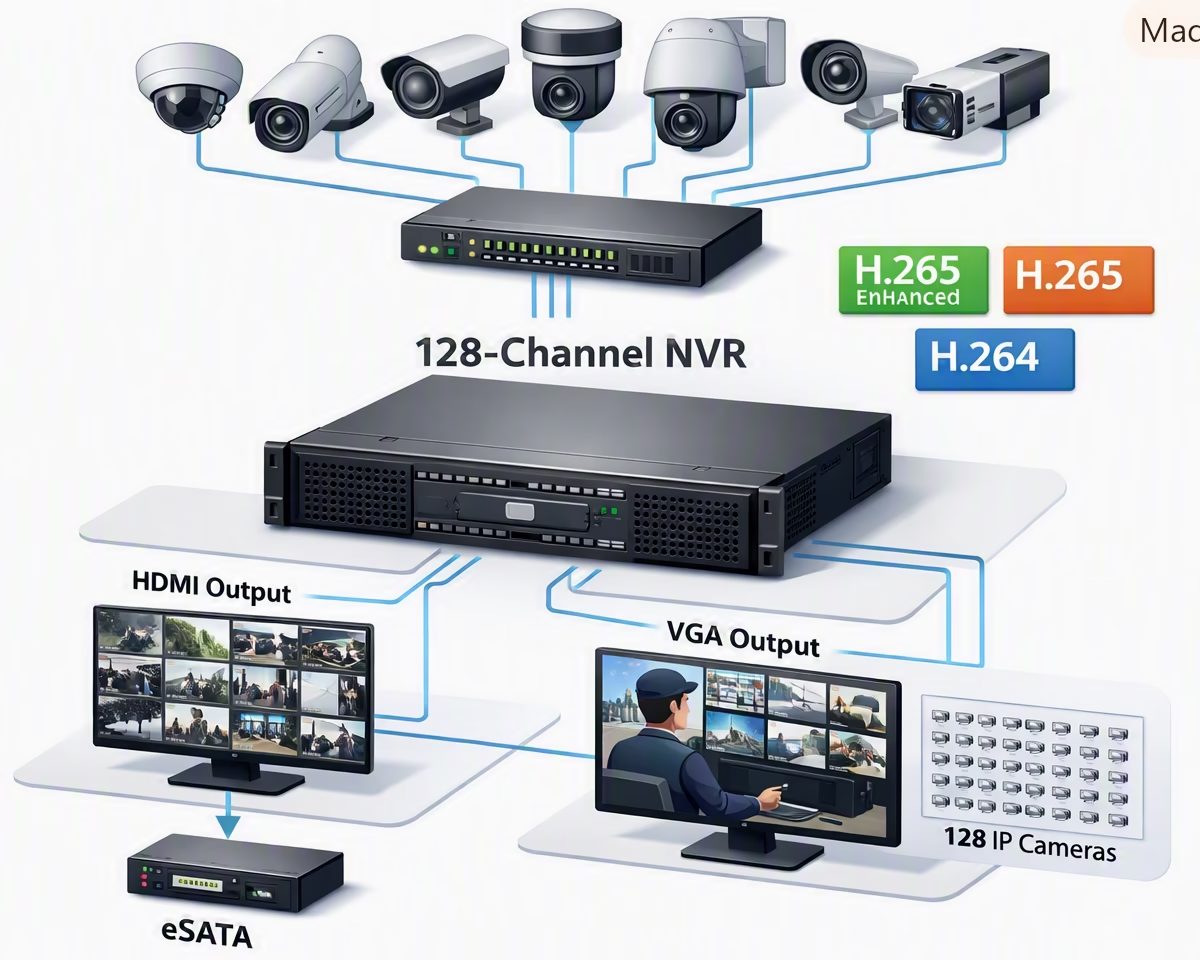
A 128‑channel NVR can ingest video streams from up to 128 IP cameras simultaneously, making it ideal for:
- Multi‑building campuses
- Industrial zones
- Large commercial complexes
- City surveillance grids
Supported Video Codecs
- H.265 Enhanced
- H.265 Standard
- H.264 High Profile
- H.264 Baseline/Main Profile
Why H.265 Matters
H.265 (HEVC) compresses video up to 50% more efficiently than H.264 — meaning:
- Lower bandwidth consumption
- Longer recording duration
- Better performance for 4K/8MP cameras
📦 2. Massive Storage Capacity: 24 Hot‑Swappable SATA Bays
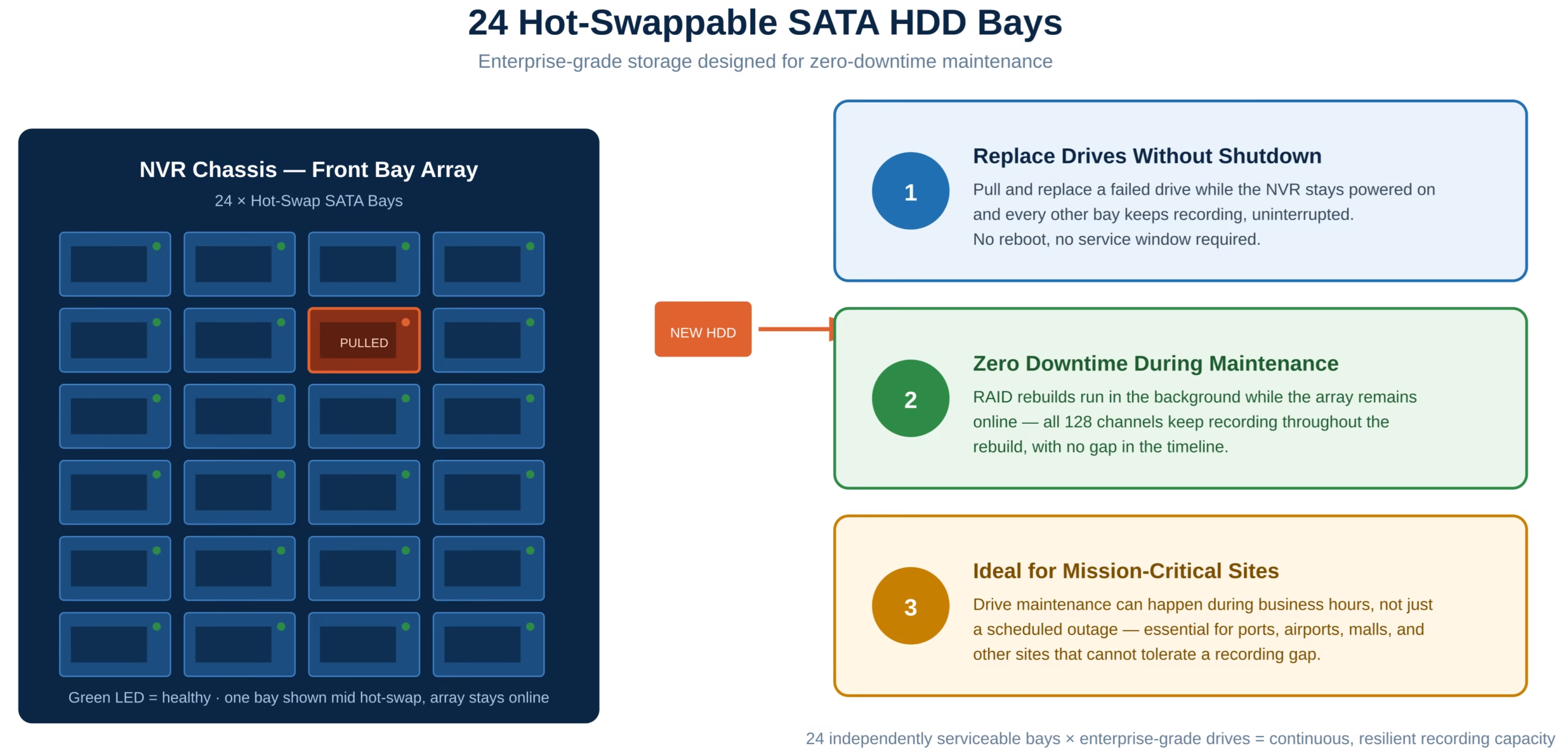
One of the strongest features of this NVR is its 24 SATA HDD bays, each supporting high‑capacity enterprise drives.
Benefits of Hot‑Swappable Bays
- Replace drives without shutting down the NVR
- Zero downtime during maintenance
- Ideal for mission‑critical environments
Typical Storage Architecture
If each bay uses a 20TB HDD, total raw storage becomes:
24 × 20TB = 480TB
With RAID applied, usable storage varies — but reliability increases dramatically.
🛡️ 3. RAID Support for Data Protection
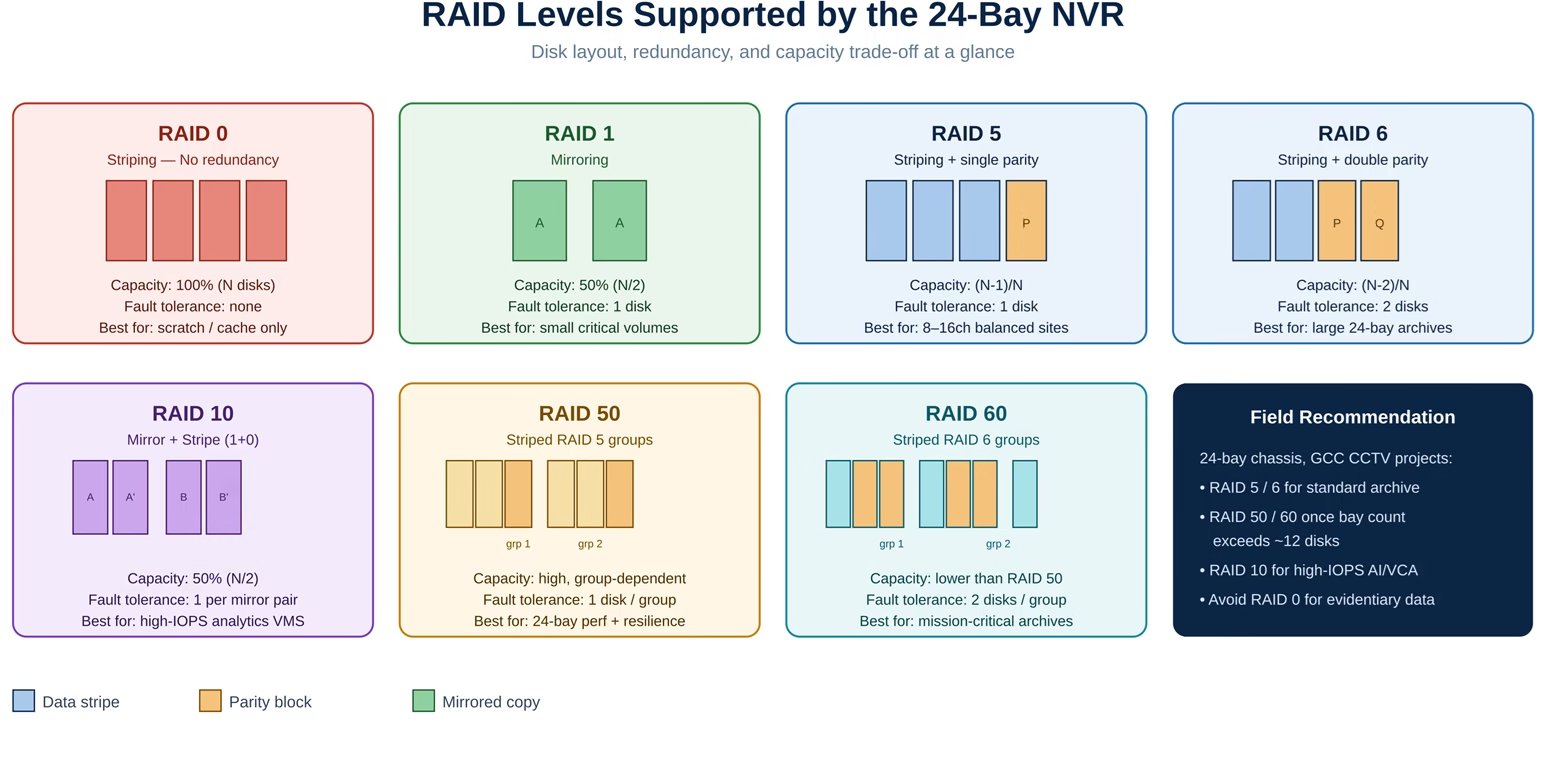
This NVR supports advanced RAID levels:
- RAID 0 – High speed, no redundancy
- RAID 1 – Mirroring for full redundancy
- RAID 5 – Balanced performance + redundancy
- RAID 6 – Survives 2 disk failures
- RAID 10 – Speed + redundancy
- RAID 50 / 60 – Enterprise‑grade multi‑array protection
Why RAID Matters in Surveillance
Surveillance data is critical evidence. RAID ensures:
- No data loss during HDD failure
- Continuous recording
- Faster rebuild times
🖥️ 4. Dual Display Output: HDMI + VGA
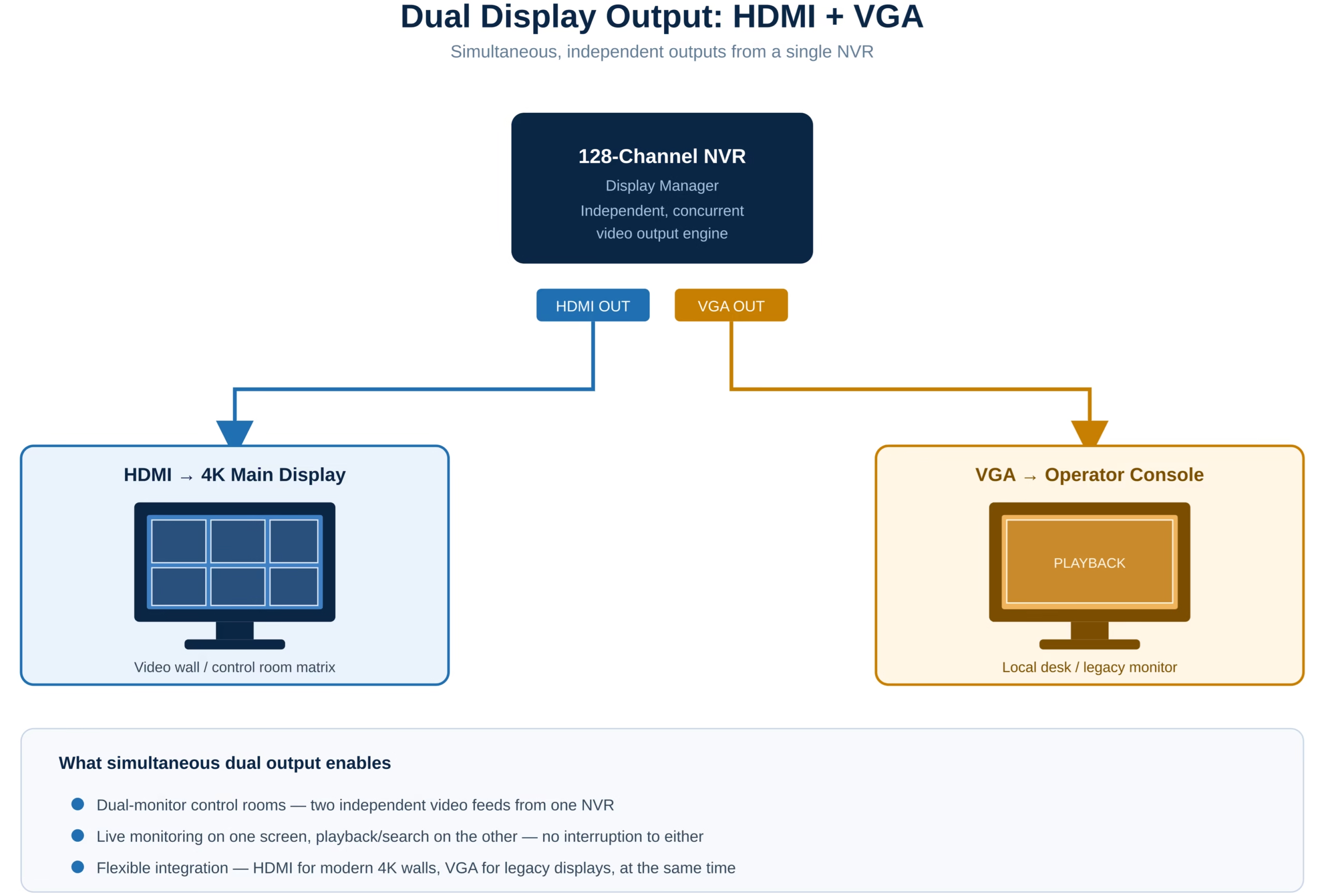
The NVR supports simultaneous HDMI and VGA output, allowing:
- Dual‑monitor control rooms
- Live monitoring + playback on separate screens
- Flexible integration with legacy and modern display systems
Typical Use Case
- HDMI → 4K main display
- VGA → Operator console
🔗 5. eSATA Interface for External Storage Expansion
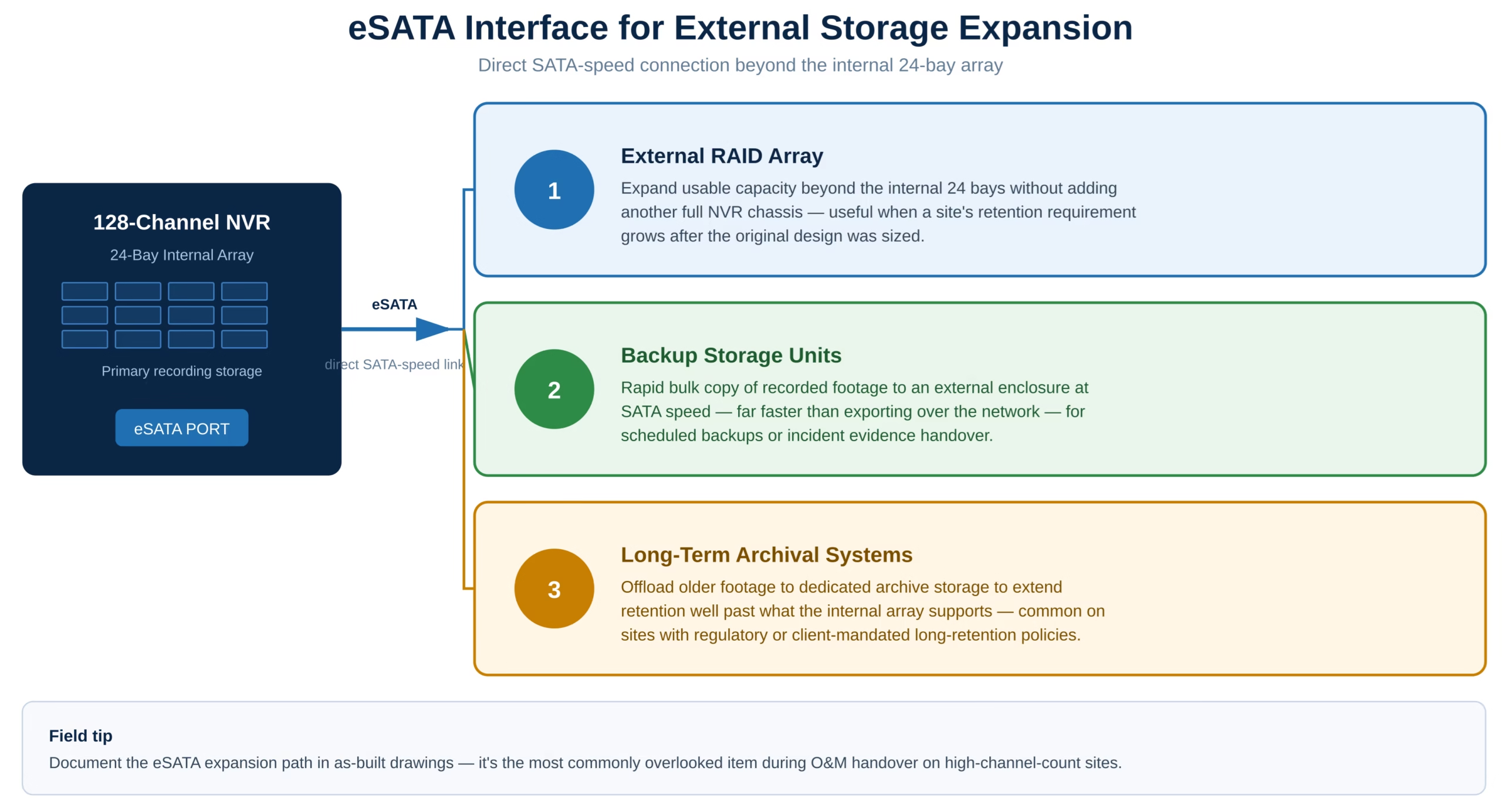
The eSATA port allows connection to:
- External RAID arrays
- Backup storage units
- Long‑term archival systems
This is especially useful for:
- Compliance‑driven industries
- Government surveillance
- Projects requiring 180–365 days retention
🌐 6. ONVIF Profile S, G, T Support
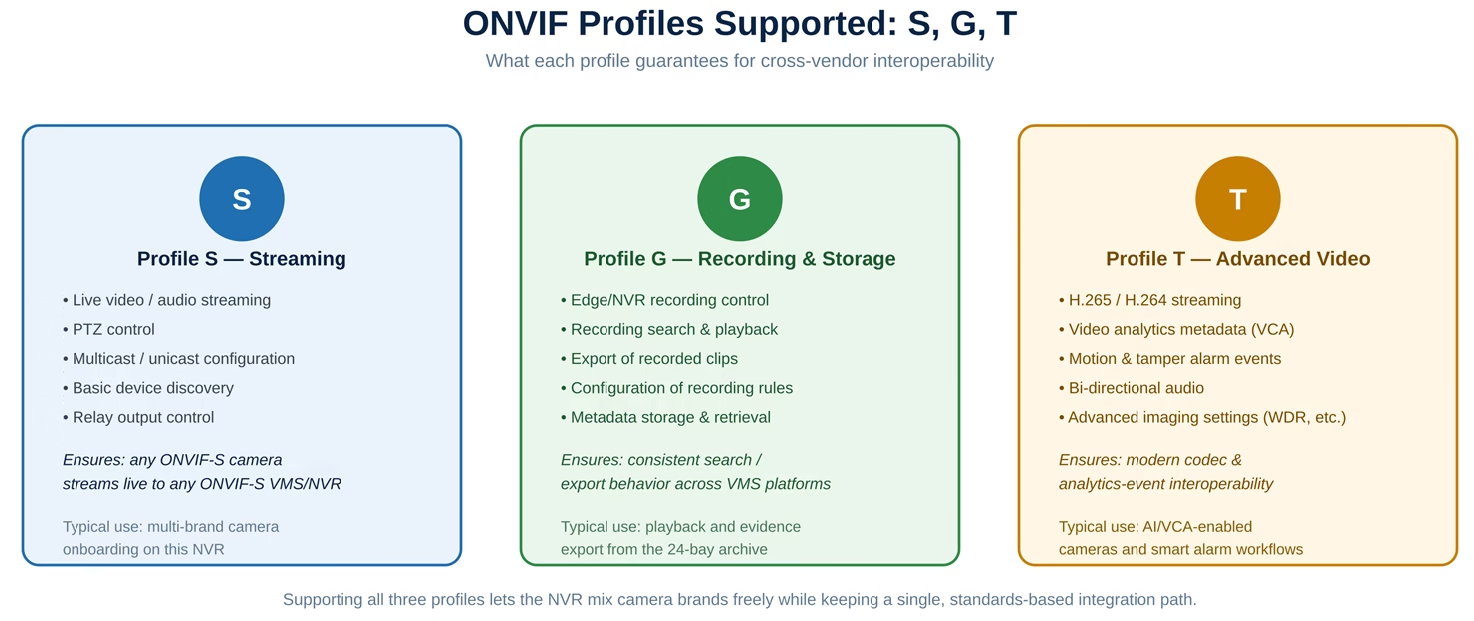
ONVIF is an open, vendor‑neutral standard that defines how IP cameras, NVRs, VMS platforms, and security software communicate. When a device supports ONVIF Profiles S, G, T, or M, it delivers video streams, events, and control functions in a manufacturer‑independent format, ensuring seamless interoperability across different brands.
Onvif Profile S
- Live video
- PTZ control
- Basic streaming
Profile G
- Edge storage
- Retrieval from SD cards
- Recording management
Profile T
- H.265 support
- Advanced imaging
- Video analytics metadata
This makes the NVR compatible with:
- AI cameras
- Thermal cameras
- LPR/ANPR systems
- Face recognition cameras
🔁 7. N+M Hot Standby Architecture
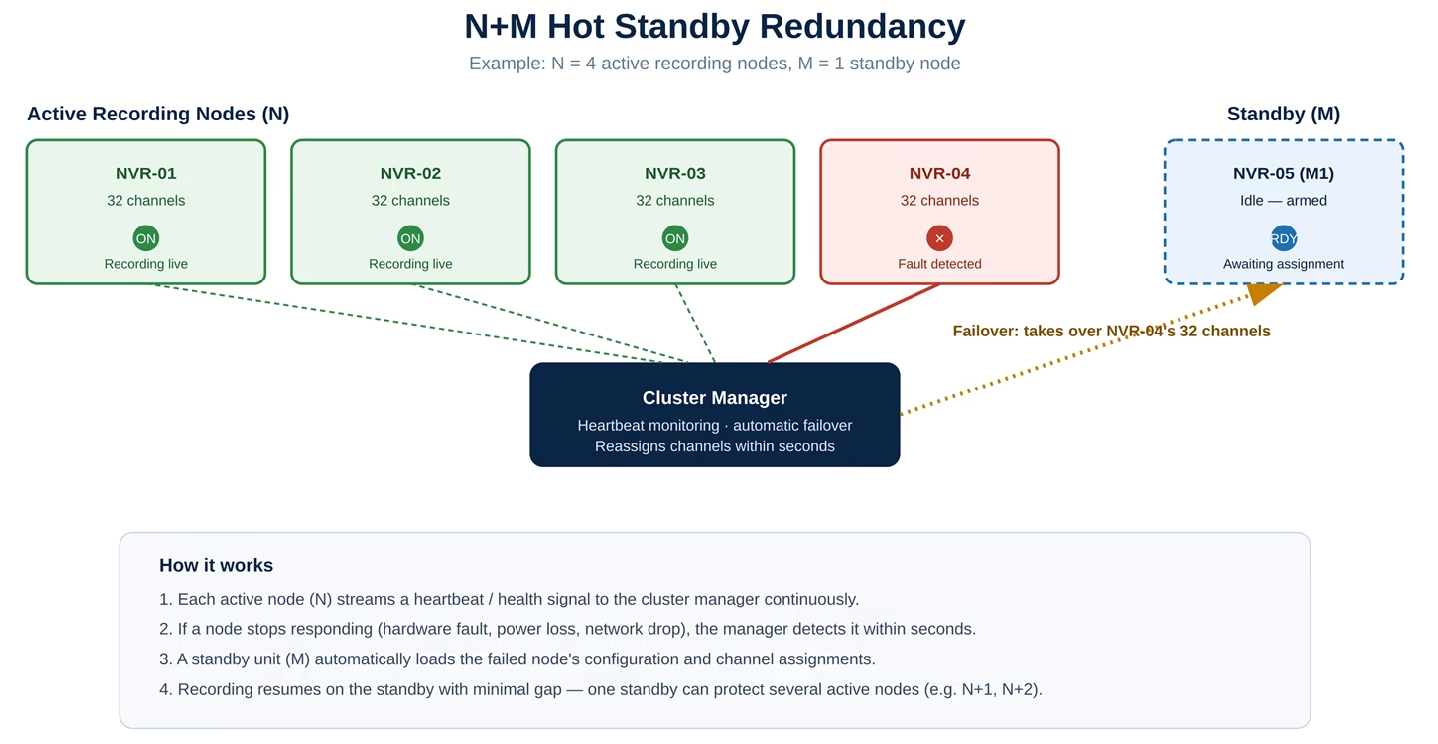
This is a high‑availability failover system.
How N+M Works
- N = Active NVRs
- M = Standby NVRs
N+M is a redundancy and failover design used in servers, storage systems, and large CCTV/NVR deployments. It ensures that even if multiple active units fail, the system continues running without interruption.
- Zero recording interruption
- No data loss
- Continuous monitoring
Ideal for
- Airports
- Metro stations
- Oil & gas facilities
- Government surveillance networks
🏗️ 8. Real‑World Deployment Example
Scenario: Smart University Campus
- 128 cameras across multiple buildings
- 24/7 recording with RAID‑6
- Dual‑monitor control room
- AI cameras for perimeter protection
- N+M failover for uninterrupted operation
This NVR becomes the central brain of the entire surveillance ecosystem.
🎯 Conclusion
The 128‑Channel Embedded Network Video Recorder is not just a storage device — it is a mission‑critical surveillance engine designed for reliability, scalability, and intelligent video management.
Its combination of:
- High‑density channel support
- Massive storage
- RAID protection
- ONVIF interoperability
- Hot standby failover
makes it the perfect choice for large‑scale professional security deployments.
