
Smart Motion Detection (SMD) is an advanced feature in modern CCTV cameras. It uses intelligent algorithms to detect motion events more accurately and efficiently. SMD distinguishes between different types of motion and minimizes false alarms. It enhances the overall effectiveness and efficiency of CCTV surveillance systems. You can use Smart Motion Detection (SMD) to identify and store human and vehicle movements in videos for quick reference.
To configure SMD For NVR /XVR follow the Steps.
Step1: Select Main Menu > AI > Parameters >SMD.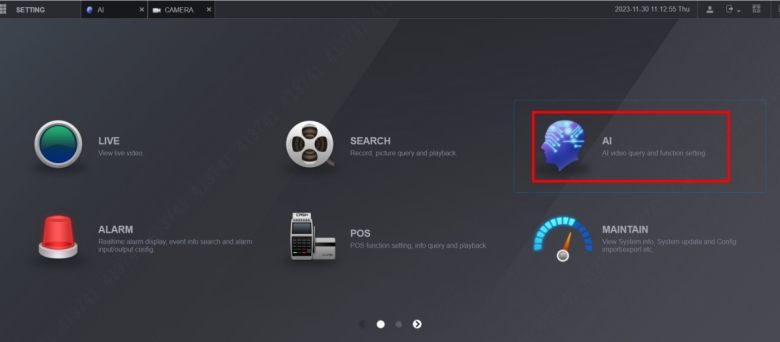
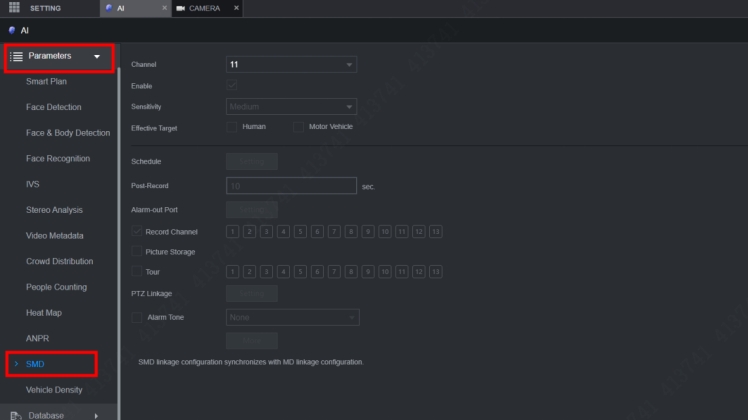
Step 2: Select a camera channel number and AI type. and enable the Function by clicking on it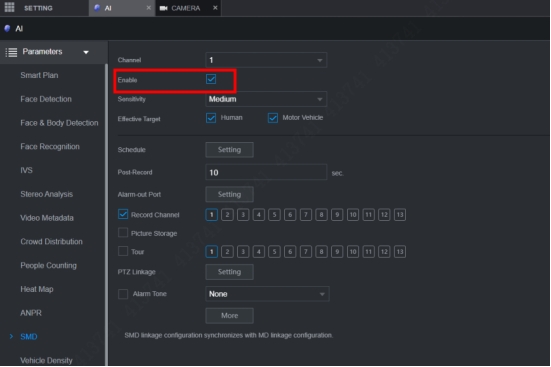
Configure the sensitivity.
The default value is recommended to minimize false alarms since a higher value can cause more frequent false alarms. Select effective targets from Human and Motor Vehicle.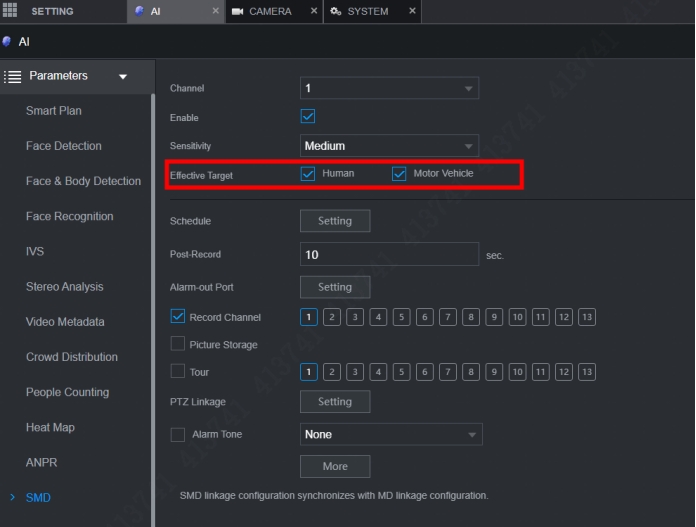
Click Setting next to schedule to configure the alarm period.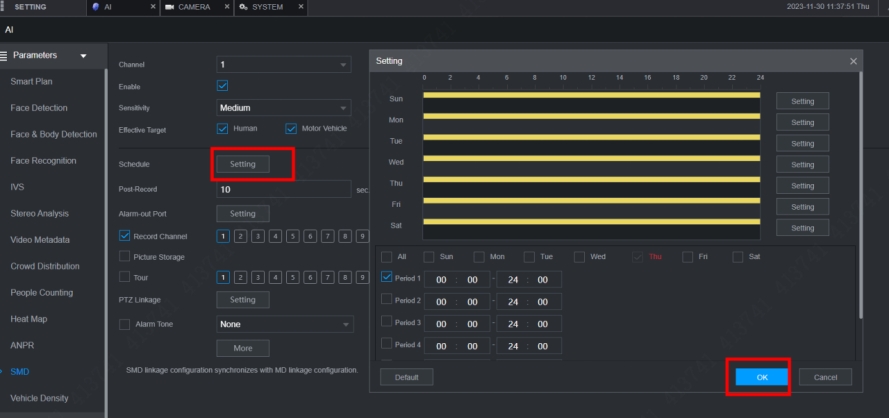
Configure alarm linkage Parameter
Anti-Dither
The system records only one motion detection event within the defined period.
Report Alarm
Enable the system to report the alarm to the alarm centre.
Note:
Make sure that the email settings have been configured in
Main Menu > NETWORK > Alarm Center.
PTZ Linkage
When an alarm occurs, the NVR associates the channel to perform the
corresponding PTZ action. For example, rotate the PTZ to the preset point.
Note:
Make sure that PTZ actions have been configured.
Tour
When an alarm occurs, the local page of the NVR displays the image of
the selected channels in turn.
Note:
Make sure that the time interval and mode for the tour have been configured in Main Menu > DISPLAY > Tour Setting
Picture Storage
When an alarm occurs, the system takes a snapshot of the channel and
stores the snapshot on the Device.
Note:
Make sure that the snapshot schedule and snapshot mode have been configured.
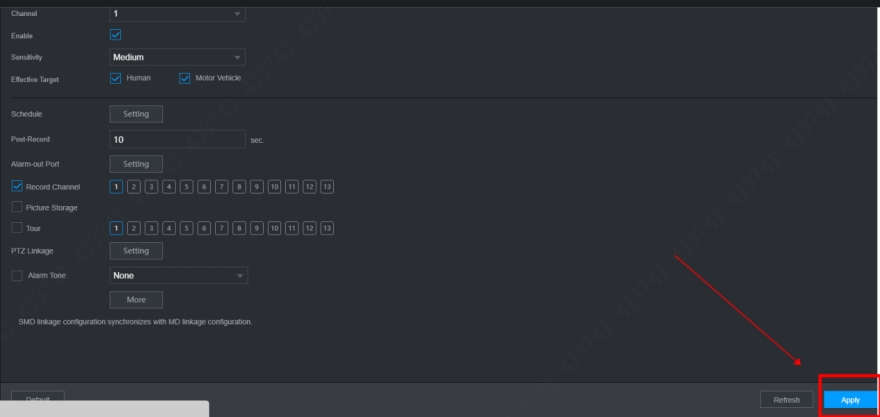
After Selecting the desired function select click on Apply/
AI Search (SMD) For PlayBack
You can use the search function to find and play videos that trigger SMD alarms.
Step1:Select Main Menu > AI > AI Search > SMD.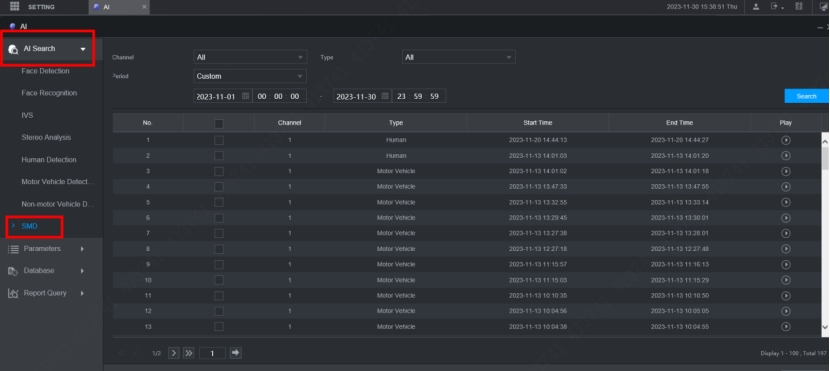
Step2:Please choose the channel, type, start time, and end time. After selecting all the required fields, please hit the “Search” button.
• Click to play back the video.
• Select a video and export it to a USB flash drive.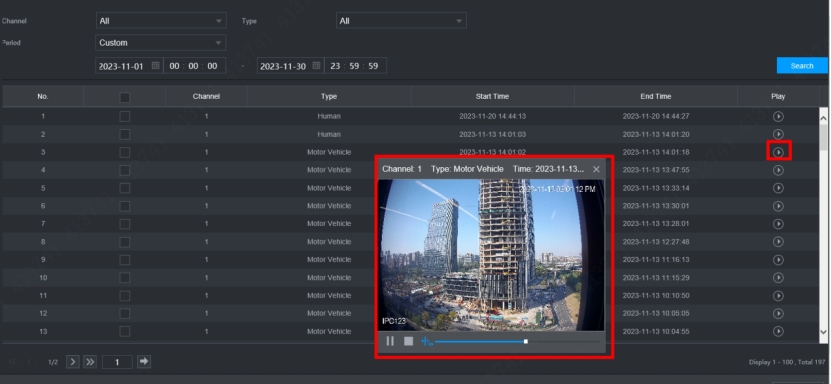
Setting Up SMD from the Web Interface
The steps above use the recorder’s local menu. You can also configure SMD remotely in a web browser. Menu names vary between firmware versions and models, so treat these as a guide.
- Log in to the recorder (or directly to the camera) by typing its IP address into a browser.
- Open the settings area and look for Event > Smart Motion Detection. On some firmware it sits under AI > Smart Plan, where SMD must first be ticked as the active AI function for that channel.
- Choose the channel. If the recorder offers AI by Camera and AI by Device, pick the one that matches where the analysis will run (see the FAQ below).
- Enable SMD, set the sensitivity, and tick the target types you care about: Human, Motor Vehicle, or both.
- Check the detection area. On many models SMD works inside the motion detection region, so mask out roads, trees and reflective surfaces in the motion detection settings first.
- Set the arming schedule and the linkage actions (record, snapshot, push notification, buzzer), then click Apply or Save.
- Walk through the scene and confirm an event appears in the alarm log or the mobile app.
Sensitivity and Target Type Tips
- Start at the default sensitivity. Raise it one step at a time only if real people are being missed. Each step up adds more false alarms from shadows, rain and insects near the IR lights.
- Choose only the targets you need. A villa gate camera may only need Human. A parking entrance usually needs both. Fewer target types means fewer unwanted notifications.
- Mind the target size. SMD needs enough pixels on the person or car to classify it. A person far away on a wide-angle lens may be too small. Use a narrower lens or move the camera closer for long driveways.
- Watch the night picture. Spider webs and insects close to the lens can trigger events at night. Keep the lens and housing clean, and avoid mounting the camera right beside a bright lamp.
Troubleshooting SMD
- The SMD option is missing or greyed out: the camera or recorder may not support it, or the firmware is too old. Check the model datasheet and update the firmware from the official source.
- SMD cannot be enabled on a channel: another AI function (for example face detection or IVS) may already be using that channel’s AI resource. Disable the other function or move it to a different channel.
- No events at all: confirm the arming schedule covers the current time, the recorder’s date and time are correct, and the motion detection region is not fully masked.
- Too many false alarms: lower the sensitivity, remove unneeded target types, mask busy areas, and increase the anti-dither time so one event does not create many alerts.
- Events are logged but nothing records: check that the record schedule includes motion or AI events and that the hard disk is healthy and not full.
- No push notifications on the phone: check that the device is online in the app, notifications are enabled for SMD on that channel, and the phone allows notifications for the app.
SMD vs Motion Detection vs IVS
| Feature | What triggers it | Best use | Limitation |
|---|---|---|---|
| Motion Detection (MD) | Any pixel change in the region | Basic recording trigger on simple indoor scenes | Many false alarms from light, shadows, rain and leaves |
| Smart Motion Detection (SMD) | Motion that the device classifies as a person or vehicle | Fewer, more useful alerts on homes, shops and small sites | Alarms anywhere in the area; no direction or line rules |
| IVS (Intelligent Video System) | A person or vehicle crossing a tripwire or entering a defined zone | Perimeters, fences, gates and restricted areas | Needs careful rule drawing and supported cameras or recorders |
In short, plain motion detection tells you that something changed, SMD tells you that a person or vehicle moved, and IVS tells you that a person or vehicle did a specific thing, such as crossing a line in one direction.
FAQ
Is SMD the same as SMD Plus?
No. SMD Plus is a newer version found on some Dahua cameras and is generally described as more accurate at filtering out non-human and non-vehicle motion. Which version you get depends on the camera model and firmware, so check the datasheet.
What is the difference between AI by Camera and AI by Device?
With AI by Camera, the camera runs the analysis and sends the results to the recorder. With AI by Device, the recorder runs the analysis on the video stream, which lets older or simpler cameras use SMD, but the recorder can only handle a limited number of AI channels.
Does SMD replace normal motion detection recording?
Not necessarily. Many installers keep continuous or motion recording for evidence and use SMD for alerts and fast searching. Decide based on your storage budget and how you review footage.
Why does SMD miss people at night?
Usually the person is too small or too dark in the image. Improve lighting or IR coverage, use a lens that gives more pixels on the target, and test sensitivity again at night.
Related tools
Planning a new CCTV layout and want to check camera positions, cabling and network links before you install? Try the free Network & CCTV Designer on techubox.com.