
Picking the wrong detector is one of the most common reasons a fire alarm system ends up with constant false alarms, or worse, a detector that reacts far too late. On site I still see smoke detectors above cookers and heat detectors in bedrooms. Both mistakes are easy to avoid once you know how each detector works.
This guide covers detector types, heat classes, typical coverage, ceiling height limits, false alarm causes and a short note for Saudi projects.
Quick Answer
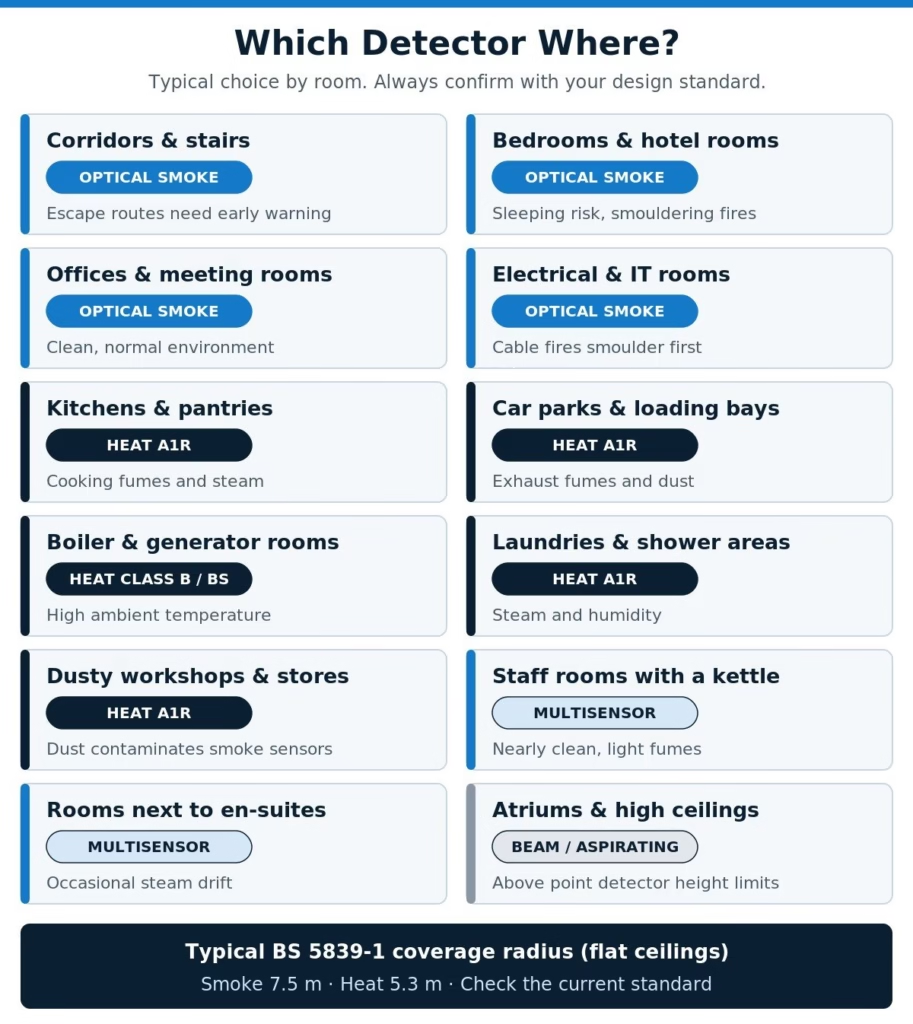
Smoke detectors (optical, ionisation or multisensor) sense smoke particles and give the earliest warning, so they are the default choice for escape routes, bedrooms, offices and most clean areas. Heat detectors react to temperature, either at a fixed value or a fast rise, so they are slower but far more stable in kitchens, car parks, boiler rooms and dusty or steamy areas where a smoke detector would false alarm. Under BS 5839-1, a point smoke detector typically covers a 7.5 m radius and a point heat detector a 5.3 m radius on a flat ceiling. Always check these values against the current edition of the standard and the detector datasheet.
How Smoke and Heat Detectors Work
Both detectors tell the panel there is a fire, but they look for different signs of it.
- Smoke detectors look for particles of combustion in the air. Most fires produce smoke well before they produce enough heat to reach the ceiling, so smoke detection gives more escape time.
- Heat detectors look for temperature. They only respond once hot gases from the fire reach the detector, which usually means the fire is already established.
The trade-off: smoke detection is faster but sensitive to the environment; heat detection is slower but tolerant of steam, dust and fumes.
Types of Smoke Detectors
Optical (photoelectric) smoke detectors
An optical detector has a small chamber with an infrared LED and a light sensor set at an angle. In clean air the light does not reach the sensor. When smoke enters, the particles scatter the light onto the sensor and the detector goes into alarm.
Optical detectors respond well to slow, smouldering fires that produce large, visible smoke particles, such as overheated cables, upholstery and bedding. This makes them the standard choice for corridors, stairs, offices, bedrooms and electrical rooms.
Ionisation smoke detectors
An ionisation detector uses a tiny radioactive source to ionise the air between two plates, which lets a small current flow. Smoke particles disrupt that current and trigger the alarm. Ionisation detectors respond well to fast, flaming fires with very small particles.
Because of the radioactive source and the rules on transport and disposal, ionisation detectors have largely been phased out of new commercial systems in many markets. You will still meet them on older sites.
Multisensor detectors
A multisensor detector combines an optical smoke sensor with a heat sensor (some models add carbon monoxide or infrared sensing). The detector or panel compares the signals before deciding to alarm. This gives good response to smouldering and flaming fires and rejects some false alarm sources that would trip a plain optical detector.
Pro tip: Multisensors are a good choice for areas that are “nearly clean”, such as hotel rooms near en-suite bathrooms or staff rooms with a kettle and microwave. Check the manufacturer’s mode settings, because many addressable multisensors can be set to different sensitivity or day/night modes, and menus vary by panel and firmware.
Types of Heat Detectors
Heat detectors are classified under EN 54-5 by the temperature range they are designed for. The class letter tells you the typical operating temperature, and a suffix tells you how the detector behaves.
Fixed temperature (static) heat detectors
A fixed temperature detector alarms when the air around it reaches a set temperature. Detectors with the S suffix (for example A1S or BS) are static types and will not alarm below their static response temperature, even if the temperature rises quickly. They are used where fast normal temperature swings are expected, such as near ovens or in boiler rooms.
Rate-of-rise heat detectors
A rate-of-rise detector alarms when the temperature climbs faster than a set rate, even if it has not reached the fixed threshold yet. Detectors with the R suffix (for example A1R) combine rate-of-rise with a fixed upper limit. A1R is the most common general-purpose heat detector on UK-style projects.
EN 54-5 heat detector classes (typical values)
| Class | Typical application temperature | Typical static response range | Where you would use it |
|---|---|---|---|
| A1 / A1R | 25 °C | 54 to 65 °C | General areas, kitchens, plant rooms at normal temperature |
| A2 / A2S | 25 °C | 54 to 70 °C | Similar to A1 where a slightly wider tolerance is acceptable |
| B / BS | 40 °C | 69 to 85 °C | Boiler rooms, warm plant rooms, loft spaces in hot climates |
| C / CS and above | 55 °C and higher | 84 °C and higher | Very hot process areas, near ovens and dryers |
Values are typical and taken from the EN 54-5 class structure. Always confirm against the detector datasheet and the current standard.
Pro tip: In Gulf and African projects, plant rooms and roof spaces can sit well above 40 °C in summer. An A1R detector there may be close to its limit on a hot afternoon. Measure or estimate the maximum normal temperature first, then pick the class.
Smoke vs Heat Detector: Side-by-Side Comparison
| Feature | Smoke detector (optical / multisensor) | Heat detector (A1R / fixed) |
|---|---|---|
| What it senses | Smoke particles (plus heat on multisensors) | Temperature or rate of temperature rise |
| Speed of response | Early, before flames spread | Later, once the fire is established |
| Life safety use | Yes, the default for escape routes and sleeping areas | Limited; mainly property protection or where smoke detection is unsuitable |
| False alarm risk | Higher in dusty, steamy or smoky areas | Low |
| Typical BS 5839-1 coverage radius | 7.5 m | 5.3 m |
| Typical ceiling height limit (BS 5839-1) | About 10.5 m | About 9 m for Class A1, 7.5 m for other classes |
| Typical locations | Corridors, stairs, offices, bedrooms, electrical and IT rooms | Kitchens, car parks, boiler rooms, laundries, dusty stores |

Where to Install Heat Detectors
The rule of thumb is simple: use smoke detection wherever you can, and switch to heat detection only where the normal environment would cause false alarms. Typical heat detector locations are:
- Kitchens and pantries: cooking fumes, toast and steam. Use A1R for normal kitchens, and consider a static (S) type near ovens and grills where temperature jumps quickly.
- Car parks and loading bays: vehicle exhaust and dust will contaminate and trip optical detectors. Heat detectors (or specialist detection designed for car parks) are common. Large open car parks may also need a fire engineering review.
- Boiler rooms, generator rooms and plant rooms: high ambient temperature and fumes. Choose the class to suit the maximum normal temperature.
- Dusty areas: workshops, carpentry shops, some warehouses and construction-phase areas.
- Steamy areas: laundries, shower areas, changing rooms and areas next to bathrooms.
- Areas with smoke as part of normal use: designated smoking rooms, welding bays.
A heat detector does not give the same early warning, so the design may still need smoke detection nearby, for example in the corridor outside the kitchen door.
Typical Coverage and Spacing Under BS 5839-1
For flat, smooth ceilings, BS 5839-1 typically limits the distance from any point in the room to the nearest detector:
- Point smoke detector: typically 7.5 m radius.
- Point heat detector: typically 5.3 m radius.
In practice this works out to a square grid of roughly 10.6 m between smoke detectors and roughly 7.5 m between heat detectors, with half of that from the walls. Other typical rules from the standard include keeping detectors at least 500 mm from walls, and mounting the sensing element within a set distance of the ceiling (typically 25 to 600 mm for smoke and 25 to 150 mm for heat).
These values change with corridors under 2 m wide, pitched or sloping ceilings, beams and obstructions, and the edition of the standard. Treat the figures here as typical and check every layout against the current edition of BS 5839-1 and the detector’s own approval. You can draft a first layout quickly with the Techubox Fire Alarm Design Tool and then verify it against the standard.
Ceiling Height Limits
On very high ceilings, smoke may stratify below the ceiling and hot gases may cool too much to trip a heat detector. BS 5839-1 therefore gives typical maximum heights for point detectors:
| Detector type | Typical general limit | Typical limit for up to 10% of the ceiling area |
|---|---|---|
| Heat detector, Class A1 | 9.0 m | 10.5 m |
| Heat detector, other classes | 7.5 m | 9.0 m |
| Point smoke detector | 10.5 m | 12.5 m |
For atriums, warehouses and halls above these heights, designers usually move to beam detectors or aspirating smoke detection. Confirm the exact limits in the current standard before you finalise the design.
Common False Alarm Causes and Fixes
| Problem | Likely cause | Fix |
|---|---|---|
| Smoke detector alarms during cooking | Optical detector too close to kitchen or pantry | Replace with A1R heat or a multisensor, or relocate away from the door |
| Alarms after showers | Steam drifting from bathroom | Move detector away from bathroom door, use multisensor or heat |
| Alarms during building works | Dust from drilling, cutting or sanding | Use approved dust covers during works and isolate zones under a permit, then remove covers |
| Random alarms on old detectors | Dirty chamber, insects, contamination | Clean or replace per manufacturer guidance; check drift values on addressable panels |
| Car park detectors alarming | Vehicle exhaust or dust on optical detectors | Change to heat detection or a type designed for car parks |
| Heat detector alarms on hot days | Class too low for normal ambient temperature | Select a higher class (for example B or BS) |
| Alarms near air conditioning | Fast airflow, condensation or dust from vents | Keep detectors away from supply grilles, typically at least 1 m |
On an addressable system, the panel log shows which device alarmed and often its contamination level. If you are deciding between system types, see our guide to addressable vs conventional fire alarm systems.
A Note for Saudi Arabia (SBC 801 and Civil Defense)
In KSA, fire alarm requirements come mainly from the Saudi Building Code, in particular SBC 801 (Saudi Fire Code), and designs are typically reviewed and approved through the Civil Defense authorities. SBC 801 generally points to NFPA 72 for fire alarm installation, so detector spacing on many Saudi projects follows NFPA 72 and the detector’s listing rather than the BS 5839-1 radii above. Requirements and approved equipment lists can change, so always check the current code edition, the project specification and the latest Civil Defense requirements before you design or buy equipment.
Installation Checklist
- Identify the system category and the standard the project follows (BS 5839-1, NFPA 72 or local code).
- List every room and its normal environment: clean, dusty, steamy, hot or fume-filled.
- Choose smoke detection by default, and heat detection only where the environment demands it.
- Select the heat class from the maximum normal ambient temperature.
- Lay out detectors using the coverage radius for each type, then adjust for beams, slopes and obstructions.
- Check ceiling heights against the limits for each detector type.
- Keep detectors away from walls, air supply grilles and light fittings.
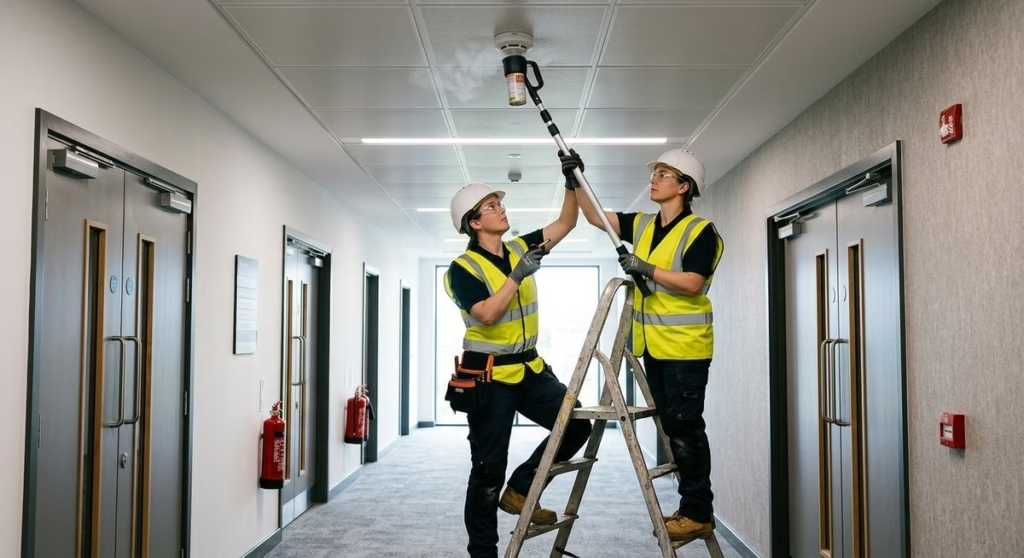
- Test every detector with the correct tool at commissioning and record the results.
For more free design calculators, visit the Techubox tools page.
Frequently Asked Questions
Is a smoke detector better than a heat detector?
For life safety, yes. Smoke detectors give much earlier warning, so they are the default for escape routes and sleeping areas. Heat detectors are better only where smoke, steam, dust or fumes are part of normal use and would cause false alarms.
Can I use a heat detector in a bedroom?
It is not recommended. A heat detector reacts late, and a smouldering fire can produce dangerous smoke long before the ceiling heats up. Bedrooms and sleeping areas should normally have smoke detection.
What does A1R mean on a heat detector?
A1 is the EN 54-5 class for detectors designed for a typical ambient of around 25 °C, with a static response typically between 54 and 65 °C. The R means it also has a rate-of-rise function, so it can alarm earlier when the temperature climbs quickly.
What is the coverage of a smoke detector under BS 5839-1?
On a flat ceiling, the typical maximum distance from any point to the nearest smoke detector is 7.5 m. For heat detectors it is typically 5.3 m. Corridors, slopes and beams change these figures, so check the current standard.
Why are ionisation detectors no longer common?
They contain a small radioactive source, which brings transport and disposal rules. Optical and multisensor detectors now cover most applications, so many manufacturers and markets have moved away from ionisation types.
Which detector should I use in a car park?
Heat detectors are commonly used because vehicle exhaust and dust can trip optical smoke detectors. Some projects use detectors designed specifically for car parks. Follow the design standard and local authority requirements for your project.