
Suitable Lens Selection for LPR/ANPR Systems
Choosing the Right Lens for LPR/ANPR — Parking, Gates & Highway Applications
The lens is arguably one of the most critical components in an LPR/ANPR (License Plate Recognition/Automatic Number Plate Recognition) system, directly impacting the accuracy and reliability of plate capture. The optimal lens choice is highly dependent on the specific application environment, as factors such as the distance from the camera to the vehicle plate, vehicle speed, lane width, and the required field of view all play a significant role in determining the appropriate specifications.
Lens for Parking Entrance/Exit
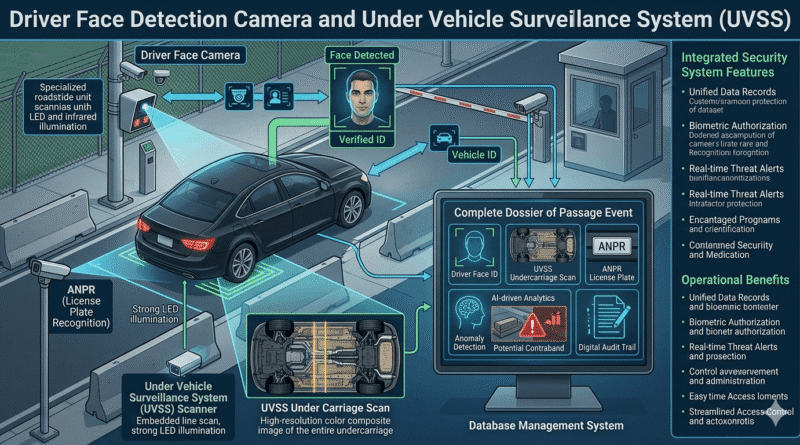
For parking entrance and exit points, where vehicle speeds are typically very low, and the capture distance is short, specific lens characteristics are essential to ensure clear and accurate plate reads.
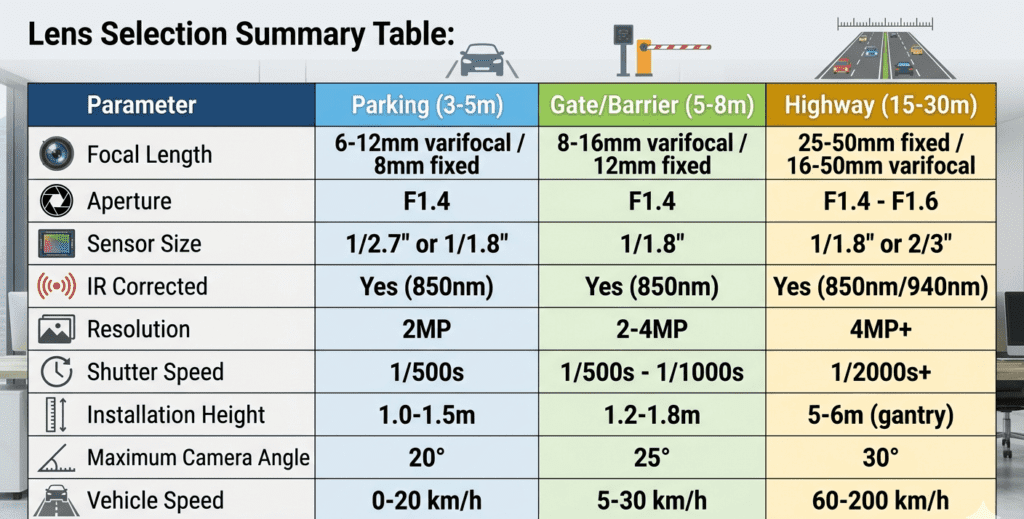
•Typical Capture Distance: 3-5 meters
•Recommended Lens: 6-12mm varifocal or 8mm fixed. A varifocal lens offers flexibility during installation, allowing for fine-tuning of the field of view.
•Focal Length Explanation: A shorter focal length provides a wider field of view, suitable for closer distances, ensuring the entire plate is captured without excessive background.
•Aperture: F1.4 or lower is recommended. A wider aperture (smaller F-number) allows more light to reach the sensor, which is crucial for optimal performance in low-light conditions, such as at night or in dimly lit parking structures.
•IR Corrected Lens (Day/Night): Essential for maintaining focus consistency between day (visible light) and night (infrared illumination) operation. Without IR correction, the image may appear blurry when the IR illuminator activates.
•Sensor Size: 1/1.8″ or 1/2.7″. Larger sensors generally offer better low-light performance and dynamic range.
•Field of View: The lens should provide a narrow enough field of view to ensure the license plate occupies approximately 15-25% of the image width. This maximises the pixel density on the plate, improving recognition accuracy.
•Installation Height: 1.0-1.5 meters. This height positions the camera to capture the license plate effectively without being obstructed by vehicle bodies.
•Camera Angle: 15-20 degrees horizontal and 10-15 degrees vertical. These angles minimize distortion and reflections, providing a clear view of the plate.
•Recommended Resolution: 2MP minimum. While 2MP is a baseline, higher resolutions can offer more detail, especially for challenging plates.
Lens for Gate/Barrier Entry (Residential, Corporate, Government)
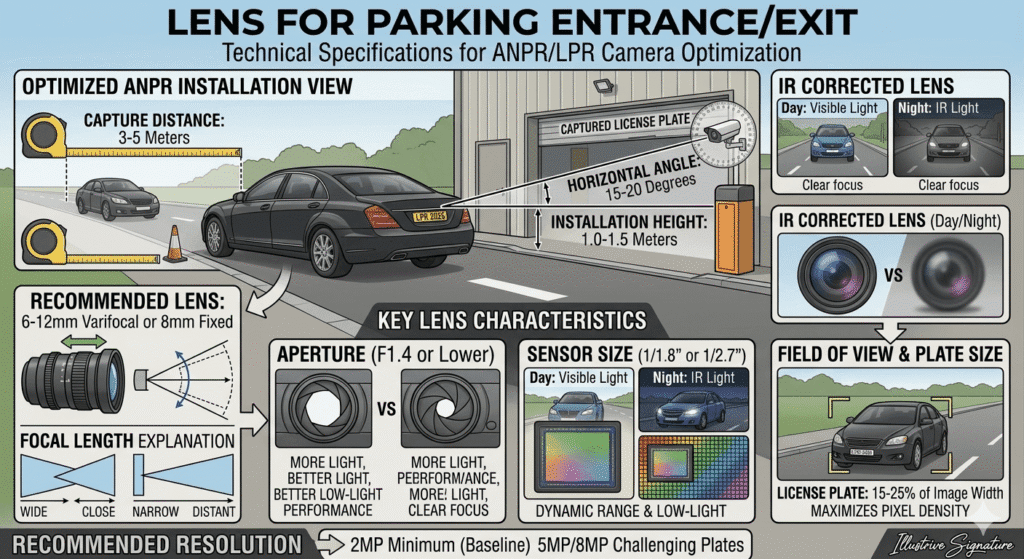
Gate and barrier entry points often involve slightly higher capture distances and vehicle speeds compared to parking entrances, necessitating a different lens approach.
•Typical Capture Distance: 5-8 meters
•Recommended Lens: 8-16mm varifocal or 12mm fixed.
•Why Varifocal is Preferred: Varifocal lenses are highly advantageous here due to their adjustability during commissioning. This allows installers to precisely set the focal length to match the specific lane width and capture distance, optimizing the field of view for accurate LPR.
•Aperture: F1.4. Similar to parking applications, a wide aperture is vital for good low-light performance.
•IR Corrected: Necessary for consistent day and night operation with IR illuminators.
•Installation Height: 1.2-1.8 meters (on pole or wall bracket). This height provides a good vantage point for capturing plates on various vehicle types.
•Camera Angle: 20-25 degrees maximum. Keeping the angle within this range helps to minimise perspective distortion.
•Recommended Resolution: 2-4MP. Higher resolution provides more detail, which can be beneficial for slightly longer distances.
•Note: For gates equipped with speed bumps, vehicle speed is typically low (5-10 km/h). This allows for a slightly lower shutter speed compared to high-speed applications, reducing motion blur while still capturing clear images.
Lens for Highway & High-Speed Applications
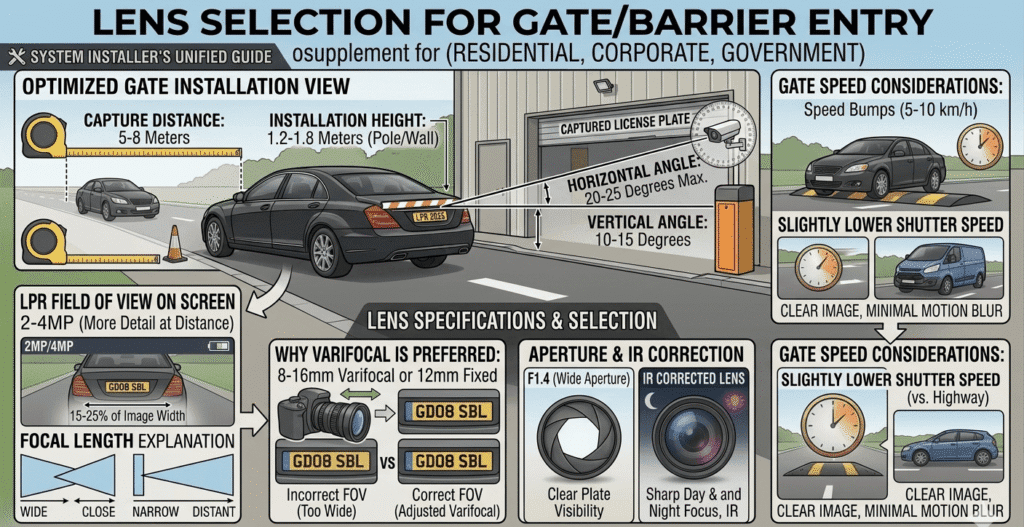
Highway and high-speed applications present the most demanding challenges for LPR/ANPR systems, requiring specialized lenses and camera technologies to cope with rapid vehicle movement and longer capture distances.
•Typical Capture Distance: 15-30 meters (or more)
•Recommended Lens: 25-50mm fixed or 16-50mm varifocal (telephoto).
•Why Long Focal Length is Needed: A long focal length (telephoto lens) is crucial to “zoom in” and ensure the license plate fills a sufficient portion of the image at greater distances. This maintains the necessary pixel density for accurate recognition.
•Aperture: F1.4 or F1.6. A wide aperture is still important for light gathering, especially given the need for very fast shutter speeds.
•Must be IR Corrected: Essential for seamless day/night transitions and clear images under IR illumination (850nm or 940nm).
•Global Shutter Preferred: A global shutter sensor captures the entire image simultaneously, eliminating the “rolling shutter” effect (distortion of fast-moving objects) that can occur with conventional sensors. This is critical for preventing motion distortion of license plates on high-speed vehicles.
•Installation Height: 5-6 meters (gantry mounted). This elevated position provides a clear, unobstructed view of the vehicle plates across multiple lanes.
•Camera Angle: 15-30 degrees. Careful angling is necessary to balance plate visibility with minimizing glare and distortion.
•Recommended Resolution: 4MP or higher. Given the longer distances and higher speeds, a higher resolution provides the necessary detail for reliable plate recognition.
•Shutter Speed: 1/2000s or faster for vehicles traveling at 120+ km/h. A very fast shutter speed is paramount to freeze the motion of rapidly moving vehicles and prevent motion blur.
•Note: In multi-lane highway scenarios, it may be necessary to deploy multiple cameras per lane. This often includes a dedicated LPR camera focused on the plate and an overview camera to capture the vehicle context.
Lens Selection Summary Table:
Pro Tips for Lens Selection:
•Always use IR-corrected lenses: Regular lenses experience a phenomenon called “focus shift” when transitioning from visible to infrared light. This means that an image perfectly in focus during the day will become blurry at night when the IR illuminator activates. IR-corrected lenses are designed to maintain focus across both visible and infrared spectrums.
•Varifocal lenses allow fine-tuning during commissioning: The ability to adjust the focal length on-site is invaluable. It enables installers to achieve the precise field of view required, ensuring optimal plate capture without physically relocating the camera.
•Motorised varifocal lenses can be adjusted remotely: For added convenience and efficiency, they can be adjusted from the Network Video Recorder (NVR) or the LPR software interface. This reduces the need for manual adjustments at the camera location.
•For the Middle East (high heat), choose lenses rated for -20°C to +60°C operating temperature: Extreme environmental conditions, such as the high temperatures prevalent in the Middle East, necessitate robust equipment. Lenses with a wide operating temperature range ensure reliable performance and longevity.
•Auto-iris (DC/P-iris) is essential for outdoor installations to handle sun glare: Auto-iris mechanisms automatically adjust the lens aperture in response to changing light conditions. This is critical in outdoor environments to prevent overexposure from bright sunlight and ensure consistent image quality throughout the day.
Driver Face Detection Camera with UVSS Integration
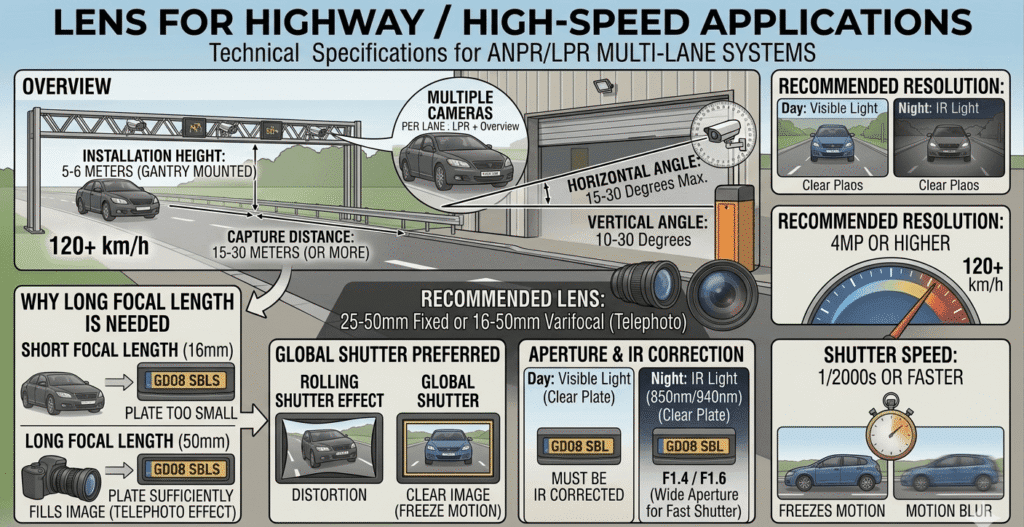
At high-security checkpoints, a comprehensive security record is paramount. While an Under Vehicle Surveillance System (UVSS) meticulously scans the vehicle’s undercarriage for anomalies and an ANPR (Automatic Number Plate Recognition) system identifies the vehicle by its license plate, a dedicated driver face detection camera completes the security triad by capturing the driver’s face. This integration creates a holistic security record, answering the critical questions of WHO is driving, WHICH vehicle they are in, and WHAT might be concealed underneath. Such systems are indispensable at sensitive locations like embassies, military bases, VIP areas, and border crossings, where verifying the driver’s identity against vehicle registration and providing irrefutable evidence in case of security incidents are crucial.
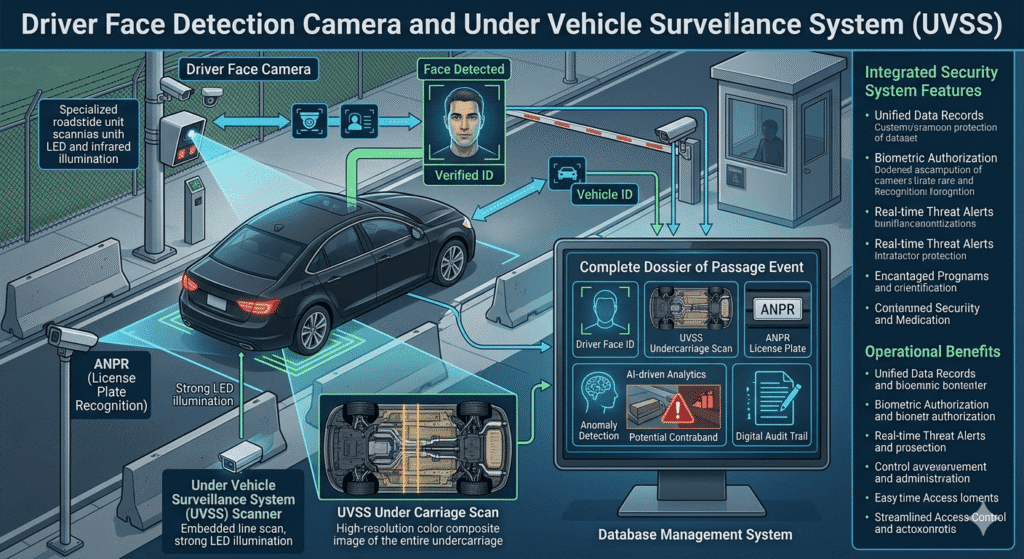
How Driver Face Detection Works at a Checkpoint
The process of driver face detection at a security checkpoint is typically orchestrated through a series of automated steps:
1.Vehicle Approaches and Slows Down: As a vehicle nears the checkpoint, it is prompted to slow down, often by speed bumps or a barrier, ensuring controlled movement.
2.ANPR Reads the License Plate: The ANPR camera captures and identifies the vehicle’s license plate, providing the initial vehicle identification data.
3.Face Detection Camera Captures Driver’s Face: Simultaneously, the face detection camera, strategically positioned, captures a clear image of the driver’s face through the windshield.
4.Vehicle Drives Over UVSS Scanner: The vehicle then proceeds over the UVSS scanner, which generates a detailed image of its undercarriage.
5.Data Linkage and Display: All three critical data points—the license plate, the driver’s face, and the undercarriage scan—are automatically linked by the system and displayed on an operator’s screen, providing a unified view.
6.Database Comparison: The captured face can be instantly compared against various databases, such as watchlists for wanted persons or authorised VIP lists, for immediate verification.
7.Decision and Alert: Based on the integrated data and database comparisons, the system can make an automated pass/fail decision or alert the operator to potential threats or discrepancies.
Recommendation for Driver Face Detection camera
Selecting the appropriate camera for driver face detection requires careful consideration of several technical specifications to ensure optimal performance, especially given the challenging conditions of capturing through a windshield.
|
Specification
|
Recommended Value
|
Reason
|
|
Resolution
|
2MP – 4MP & Higher
|
Provides sufficient detail for accurate facial feature recognition and identification.
|
|
Lens Type
|
Fixed or varifocal
|
The choice depends on the specific lane width and the fixed distance from the camera to the driver’s position. Varifocal offers greater flexibility during installation.
|
|
Focal Length
|
12-25mm
|
A narrower field of view is essential to focus precisely on the driver’s window area, minimizing extraneous background.
|
|
Aperture
|
F1.4 or lower
|
A wide aperture is critical for excellent low-light performance, which is often encountered when capturing through tinted or shadowed windshields.
|
|
WDR (Wide Dynamic Range)
|
120dB or higher
|
CRITICAL: High WDR is paramount to handle extreme contrast variations, such as a bright sky or exterior lighting behind a potentially dark or tinted windshield, ensuring both bright and dark areas are clearly visible.
|
|
IR Illuminator
|
850nm (visible red glow) or 940nm (invisible)
|
Infrared illumination is necessary to penetrate tinted windshields and provide clear images during nighttime operations or in low-light conditions. 940nm is preferred for covert operations as it is invisible to the human eye.
|
|
Shutter Speed
|
1/500s minimum
|
A fast shutter speed is required to prevent motion blur, even at the relatively slow speeds vehicles move through checkpoints.
|
|
AI Features
|
Face detection, face capture, face comparison
|
Smart cameras with built-in AI analytics can automatically detect faces, capture high-quality images, and perform real-time comparisons against databases, enhancing efficiency and accuracy.
|
|
Weatherproofing
|
IP67 minimum
|
Essential for outdoor installations to protect against dust, rain, and other environmental elements.
|
|
Operating Temp
|
-30°C to +60°C
|
Ensures reliable operation in diverse and extreme climatic conditions, such as those found in the Middle East.
|
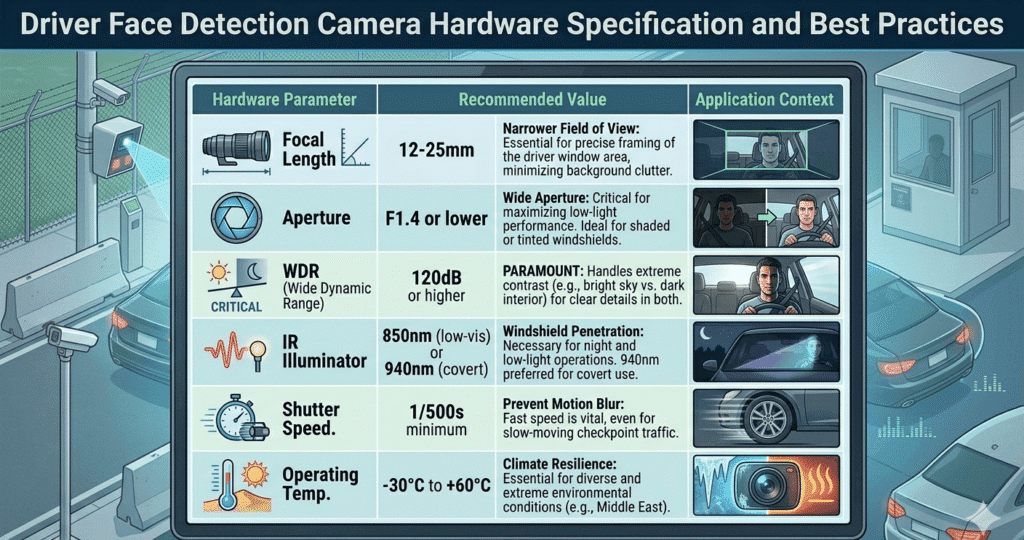
Proper Lens for Driver Face Detection
Beyond general camera specifications, the lens choice for driver face detection has specific requirements to overcome the unique challenges of capturing through a vehicle windshield.
•Distance from Camera to Driver: Typically, the optimal capture distance is between 3 – 6 metres.
•Capturing Through Windshield: This presents challenges due to glass reflections and potential tinting. The lens must be capable of minimizing these effects.
•Recommended Focal Length: A 12mm lens is generally suitable for distances of 3-4 metres, while a 16-25mm lens is recommended for longer distances of 5-8 meters. The goal is to achieve a narrow field of view that tightly frames the driver’s window area.
•Must be IR Corrected: As with LPR cameras, an IR-corrected lens is vital for consistent focus and clarity during both day and night operations when IR illuminators are active.
•Polarizing Filter (Optional): A polarizing filter can be a valuable addition to the lens, especially during daytime, as it significantly reduces glare and reflections from the windshield, improving image quality.
•Auto-iris Essential: An auto-iris (DC/P-iris) lens is crucial for outdoor installations. It dynamically adjusts the aperture to compensate for varying light conditions, from bright sunlight to shadows, ensuring optimal exposure and preventing image washout or underexposure.
Correct Height and Positioning of the Camera
Correct installation height and positioning are critical for the successful operation of a driver face detection camera. Improper placement can lead to reflections, obstructions, and, ultimately, missed captures.
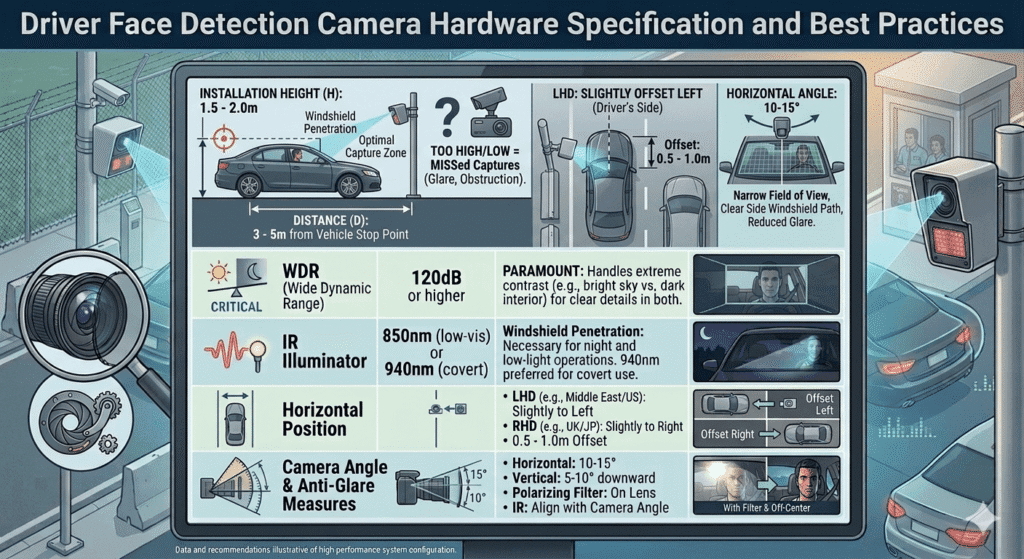
•Installation Height: 1.5 – 2.0 meters (5-6.5 feet)
•Why: The camera must be positioned at approximately the same height as the average driver’s face. If it’s too low, it risks capturing the dashboard or steering wheel instead of the driver’s face.
•Horizontal Position: Slightly Offset to Driver’s Side
•In Right-Hand Drive Countries (e.g., UK, Japan): The camera should be positioned slightly to the right of the lane center.
•In Left-Hand Drive Countries (e.g., USA, Europe, Middle East): The camera should be positioned slightly to the left of the lane center.
•Offset: An offset of 0.5-1.0 meter from the lane center towards the driver’s side helps to achieve a better angle for capturing the driver’s face, reducing direct reflections and providing a clearer view through the side of the windshield.
•Distance from Vehicle Stop Point: 3-5 meters Ahead
•The camera should be positioned 3-5 meters ahead of where the vehicle is expected to stop or slow down significantly
•Horizontal Angle: 10-15 degrees. A slight horizontal angle, rather than a head-on view, helps to minimize direct glare and reflections from the windshield.
•Vertical Angle:<span data-slate-node=”text”> 5-10 degrees downward. A minimal downward tilt is usually sufficient to capture the face without excessive reflections.
•Anti-Glare Measures:
•Install Camera Slightly Off-Center: As mentioned, avoiding a direct head-on angle to the windshield is crucial.
•Use Polarizing Filter on the Lens: This can significantly reduce glare from the glass.
•Position IR Illuminator at Same Angle as Camera: Ensuring the IR illuminator is aligned with the camera’s angle helps to optimize IR penetration through the windshield and minimise reflections.
•Avoid Placing Camera Where Sun Reflects: Careful site survey and planning are needed to avoid positioning the camera where direct sunlight or other bright light sources will reflect off the windshield into the lens.
Height: 1.5-2.0m Distance: 3-5m from stop point
Integration with UVSS and ANPR
To create a robust, multi-layered security solution.
•Single Management Software: A unified software platform is used to link and manage all data streams from the ANPR, UVSS, and face detection cameras.
•Triggered Capture: When the ANPR system successfully reads a license plate, it can automatically trigger the face detection camera to capture the driver’s image, ensuring synchronisation of data.
•Data Storage:<span data-slate-node=”text”> The captured face image is stored alongside the corresponding license plate number and the UVSS undercarriage scan, creating a comprehensive record for each vehicle entry.
•Unified Dashboard: Security operators are presented with a unified dashboard that displays all relevant information: the vehicle’s license plate, the driver’s captured face, and the undercarriage image. This allows for quick and informed decision-making.
•National Database Integration: For enhanced security, the system can be integrated with national or international databases, enabling real-time alerts for wanted persons or verification against authorised personnel lists.
Key Considerations:
•Tinted Windshields: The use of 850nm IR illuminators is crucial as they can penetrate most common windshield tints. For very dark tints, 940nm IR illuminators may be more effective, as they penetrate even deeper.
•WDR is the Most Important Feature: The extreme contrast between the bright exterior and the potentially dark interior of a vehicle, especially through a windshield, makes a high Wide Dynamic Range (WDR) capability the single most critical camera feature for driver face detection.
•Night Operation:<span data-slate-node=”text”> For effective night operation, the IR illuminator must be sufficiently powerful to illuminate the driver’s face through the glass, overcoming any reflections or tinting.
•Privacy Laws: You must be aware of and comply with local privacy laws and regulations regarding facial capture.
•Storage: Face images, especially high-resolution ones, can consume significant storage space. Proper planning for data storage and retention policies is essential.
Conclusion
The LPR ANPR UVSS system ecosystem is vital for modern physical security. To inspect for hidden threats. They create fast, automated, and highly secure checkpoints. Proper camera selection, positioning, and software utilisation ensure facility safety and efficiency. Visit Techubox: How to Calculate CCTV Storage Requirements, Building an Offshore Surveillance and Well Monitoring System, Marine-Grade Cameras for Cargo Ships)
