
Guide to AI CCTV for Automatic Spill Detection & ESD Integration
In high-stakes industrial environments like oil & gas refineries, chemical plants, and offshore platforms, the flare system is the final line of defense. Its purpose is to safely combust excess hydrocarbons during pressure-relief events. However, the area around the flare—the flare pit or knock-out drum—is itself a major hazard area for liquid spillage and accumulation. Traditional monitoring, reliant on periodic human inspection or basic sensors, is fraught with risk and latency.
Enter the era of “Smart Flares.” This concept leverages advanced AI-powered CCTV systems to provide real-time, automatic visual intelligence for spill detection, directly integrated with Emergency Shutdown (ESD) systems to enable immediate, automated response.
This technical guide delves into how this synergy of computer vision and process safety works, the critical certifications required, and its practical implementation.
The Problem: Limitations of Traditional Flare Monitoring
Traditional methods for monitoring flare pits and bunds are reactive and inadequate:
-
Periodic Patrols: Manual inspections are infrequent, potentially allowing a spill to go undetected for hours, increasing the risk of fire, environmental damage, and regulatory fines.
-
Point-Source Sensors: Level transmitters or hydrocarbon sensors offer only a localized reading. They can miss spills that originate away from the sensor or fail to provide contextual visual data about the source and spread.
-
Operator Fatigue: Monitoring standard CCTV feeds is a tedious task, and critical events can be missed during a lapse in attention, especially at night or in poor weather.
The Solution: AI-Powered CCTV for Automated Visual Intelligence
An AI CCTV system transforms a standard video feed into an intelligent, automated hazard detection sensor. Here’s a breakdown of the core technology:
1. The AI Vision Engine: Convolutional Neural Networks (CNNs)
At the heart of the system is a pretrained Convolutional Neural Network (CNN), a class of deep learning models exceptionally effective at analyzing visual imagery.
-
Training Data: The CNN is trained on thousands of annotated images and video sequences of flare pits in various states—empty, normal rainfall, with controlled water layers, and with actual hydrocarbon spills (simulated or historical). The model learns to distinguish between a benign sheen from rain and the distinct visual characteristics of an oil spill (e.g., specific texture, colour, and movement patterns).
-
Inference at the Edge: For low-latency response, the AI model runs on edge computing devices (like an NVIDIA Jetson or similar industrial GPU) located near the cameras. This allows for real-time analysis without the latency and bandwidth issues of sending video to a cloud server.
2. The Spill Detection Workflow
-
Continuous Frame Analysis: The edge device analyses every frame of the video stream from strategically placed, ruggedised cameras (often with thermal or low-light capabilities).
-
Pixel-Wise Segmentation: The AI doesn’t just detect a spill; it can perform semantic segmentation, identifying and outlining the exact pixels belonging to the spilt liquid. This allows for quantification of the spill area.
-
Alarm Triggering: When the confidence level of a spill detection exceeds a predefined threshold (e.g., 95%), the system triggers an alarm.
The Critical Link: Integration with the Emergency Shutdown (ESD) System
Detection alone is not enough. The true power of a Smart Flare system is its seamless integration with the plant’s Safety Instrumented System (SIS) and ESD.
How the Integration Works:
-
Hardwired Signal or Secure Protocol: Upon confirmed detection, the AI system sends a signal to the Safety PLC. This is typically done via:
-
Hardwired Dry Contact Relay: A physical, failsafe connection that changes state (e.g., from open to closed) to signal an alarm. This is the most common and robust method for high-integrity safety systems.
-
Industrial Protocol (OPC UA, Modbus TCP/IP): A digital communication over the plant’s secure network. This method can carry more data (e.g., spill location, size) but must be implemented with stringent cybersecurity measures.
-
-
Logic Solver (Safety PLC): The Safety PLC receives the signal and executes a pre-programmed Safety Instrumented Function (SIF).
-
Final Element Action: The SIF initiates automatic actions through final elements, which may include:
-
Closing specific block valves upstream of the flare pit.
-
Isolating the source of the leak if it can be determined.
-
Activating containment pumps or diversion systems.
-
Triggering plant-wide or unit-specific ESD sequences if the spill severity warrants it.
-
Technical & Hazard Certifications: Non-Negotiable for Implementation
Integrating a visual-based system into a safety-critical ESD loop demands rigorous certification to ensure functional safety and reliability.
| Certification/Standard | Purpose & Relevance to Smart Flares |
|---|---|
| IEC 61508 / IEC 61511 | The foundational international standards for functional safety of electrical/electronic/programmable electronic safety-related systems. The entire AI-ESD integration must be designed and validated per these standards. |
| Safety Integrity Level (SIL) | A relative level of risk reduction provided by a safety function. A Smart Flare spill detection SIF would typically be rated SIL 2. This requires proven high availability, a low Probability of Failure on Demand (PFD), and a robust architecture with redundancy. |
| ATEX / IECEx Zone Certification | The cameras, housings, and edge computing devices must be certified for use in the hazardous area where they are installed (e.g., Zone 1 or Zone 2 for explosive atmospheres). This ensures they cannot become an ignition source. |
| Ingress Protection (IP) Rating | Equipment must have a high IP rating (e.g., IP66/IP67) to withstand harsh environments—dust, water jets, and corrosive atmospheres. |
| NEMA 4X | A U.S. standard equivalent to high IP ratings, indicating protection against windblown dust, rain, sleet, and hose-directed water. |
| Cybersecurity (IEC 62443) | As a networked device, the AI system must be hardened against cyber threats to prevent malicious manipulation of safety signals. |
Real-World Application Examples
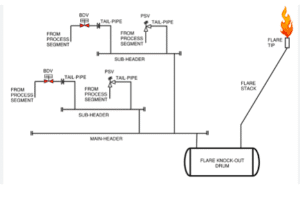
Example 1: Offshore Oil Platform—Flare Knock-Out Drum
-
Challenge: The knockout drum, designed to separate liquid carryover, experienced an unexpected valve failure, leading to a continuous hydrocarbon liquid discharge into the flare line.
-
Smart Flare Solution: A thermal AI CCTV was trained to detect the specific thermal signature of hydrocarbon liquid accumulating in the base of the flare stack. Upon detection, the system sent a signal to the ESD, which automatically isolated the flare line and diverted the gas to a backup flare, preventing a major environmental incident.
-
Certifications: SIL 2, ATEX Zone 1.
Example 2: Chemical Plant Flare Pit
-
Challenge: Heavy rainfall could sometimes cause the flare pit to fill with water, making it difficult for operators to distinguish between water and a chemical spill from a leaking pipeline.
-
Smart Flare Solution: A dual-spectrum (visual and thermal) AI system was deployed. The model was specifically trained to differentiate between water and various process chemicals based on visual opacity, surface texture, and thermal emissivity. It could trigger a high-level alarm only for chemical spills, while simply logging high water levels from rain.
-
Certifications: IEC 61511, IP67, NEMA 4X.
Conclusion: The Future of Flare Safety is Proactive and Visual
The integration of AI-powered CCTV for automatic spill detection and ESD integration marks a paradigm shift from reactive to proactive process safety. By providing a continuous, intelligent, and contextual “eye” on critical assets, Smart Flares significantly reduce the time between a spill initiation and its mitigation.
For engineers and safety managers, the path forward involves selecting technology partners who not only understand AI but, more importantly, possess deep expertise in functional safety standards like IEC 61511 and can deliver a SIL 2 capable, cyber-secure solution. In the relentless pursuit of operational excellence and environmental stewardship, Smart Flares are not just an innovation; they are a necessity.
FAQ Section:
Q: What is the difference between a DCS and an ESD/SIS?
A: The DCS (Distributed Control System) manages continuous process operations. The ESD/SIS (Emergency Shutdown/Safety Instrumented System) is a separate, dedicated system designed specifically for safe shutdown in hazardous situations. They are often integrated but remain independent for safety.
Q: Can the AI distinguish between rain and an oil spill?
A: Yes. A robust AI model is trained on diverse data, including various weather conditions. It analyzes multiple visual features (texture, movement, and thermal signature) to differentiate between water (rain) and hydrocarbon liquids with high accuracy.
Q: What is the typical response time of such a system?
A: From detection to a signal being sent to the ESD panel, a well-designed system can act in under 5 seconds, far faster than human reaction.