
Catching Fires Without Anyone Watching
How video analytics turn an ordinary CCTV network into an early-warning fire system — with a real integration example and a working configuration table.
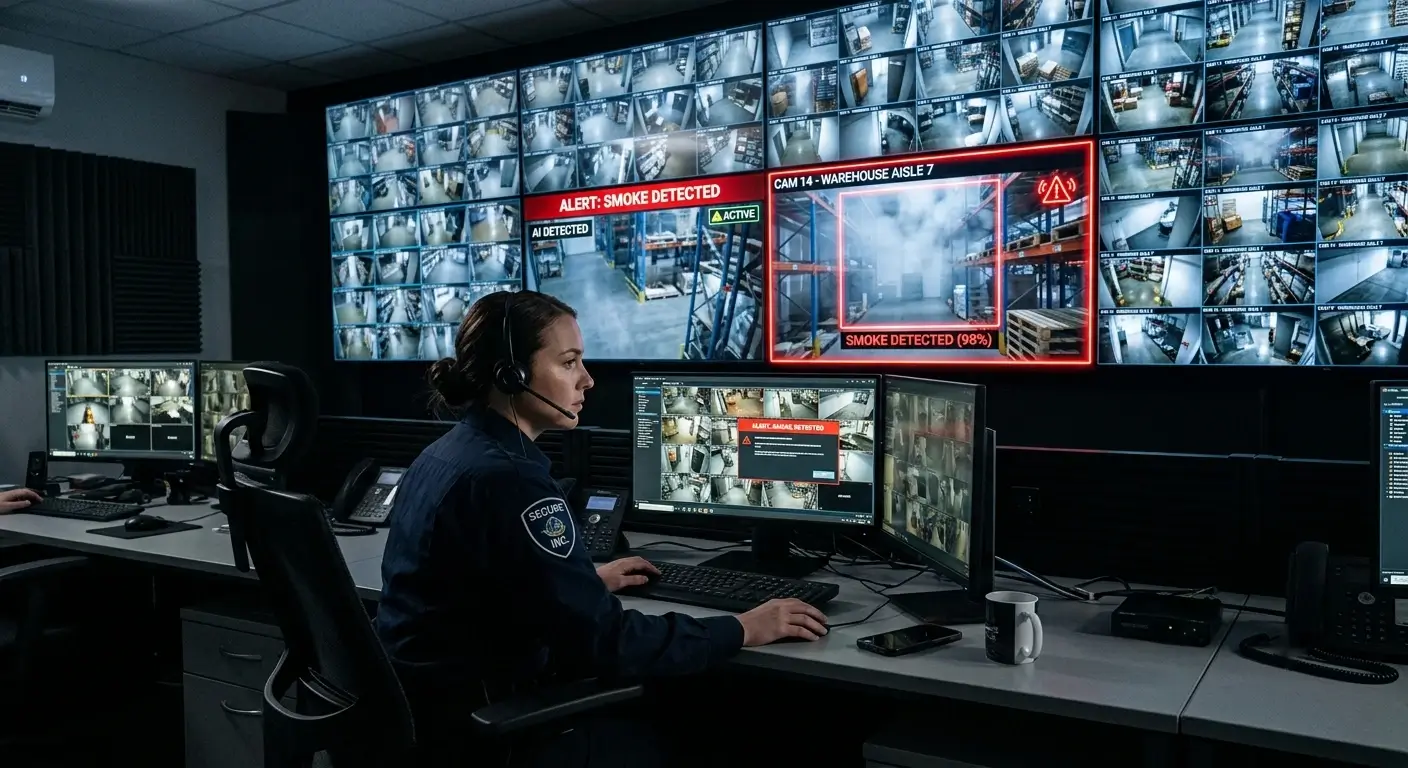
Every operator room I’ve walked into in the last few years has the same problem. A dozen monitors, sixty-plus camera feeds cycling on a wall, and one tired guard on a night shift who is realistically watching maybe three screens at a time. Smoke doesn’t announce itself politely in the middle of that rotation. By the time someone notices a haze building in a warehouse aisle, it’s often already a fire, not a warning sign.
That’s the gap AI-based fire and smoke detection on CCTV is built to close. It’s not about replacing your certified fire alarm system it’s about giving an eye that never blink and only interrupting a human when something actually looks like smoke or flame.
Why “Continuous Monitoring” Was Never a Real Solution
The traditional assumption behind CCTV was that a human being is watching or at least reviewing footage after an incident. In practice, that assumption breaks down fast:
- Operators fatigue after 20 minutes of sustained screen attention, regardless of training.
- Large sites (malls, warehouses, labor camps, substations) run far more cameras than any control room can watch live.
- Fires in storage and industrial areas often start in unoccupied hours, exactly when staffing is lowest.
- Conventional smoke detectors need smoke to physically reach the sensor chamber — which can take minutes in a high-ceiling warehouse or an open corridor.
AI video analytics attack this from a different angle: instead of waiting for smoke to travel to a sensor, or for a human to happen to be looking at the right monitor, the camera’s own video stream is analyzed frame by frame for the visual signature of smoke and flame.
How the Detection Actually Works
Modern AI fire/smoke analytics — whether running at the edge on the camera itself (Hikvision AcuSense, Dahua WizMind, and similar lines) or server-side on a VMS/NVR — use a combination of techniques rather than a single trick:
- Deep learning classifiers trained on smoke plume texture, colour gradients, and motion patterns distinct from steam, dust, or fog.
- Flame detection models looking for the flicker frequency and colour signature specific to combustion, not just any bright or moving light source.
- Temporal confirmation — requiring the pattern to persist across several consecutive frames before raising an event, which is what keeps false alarms manageable.
- Region of Interest (ROI) masking so the engine ignores irrelevant areas like sky, traffic, or reflective surfaces.
This is genuinely different from the old-school “motion + colour threshold” video smoke detection that gave the whole category a bad reputation a decade ago. The deep-learning models are far better at telling the difference between a genuine smoke plume and a passing cloud of dust from a forklift.
Why This Doesn’t Need Continuous Human Monitoring
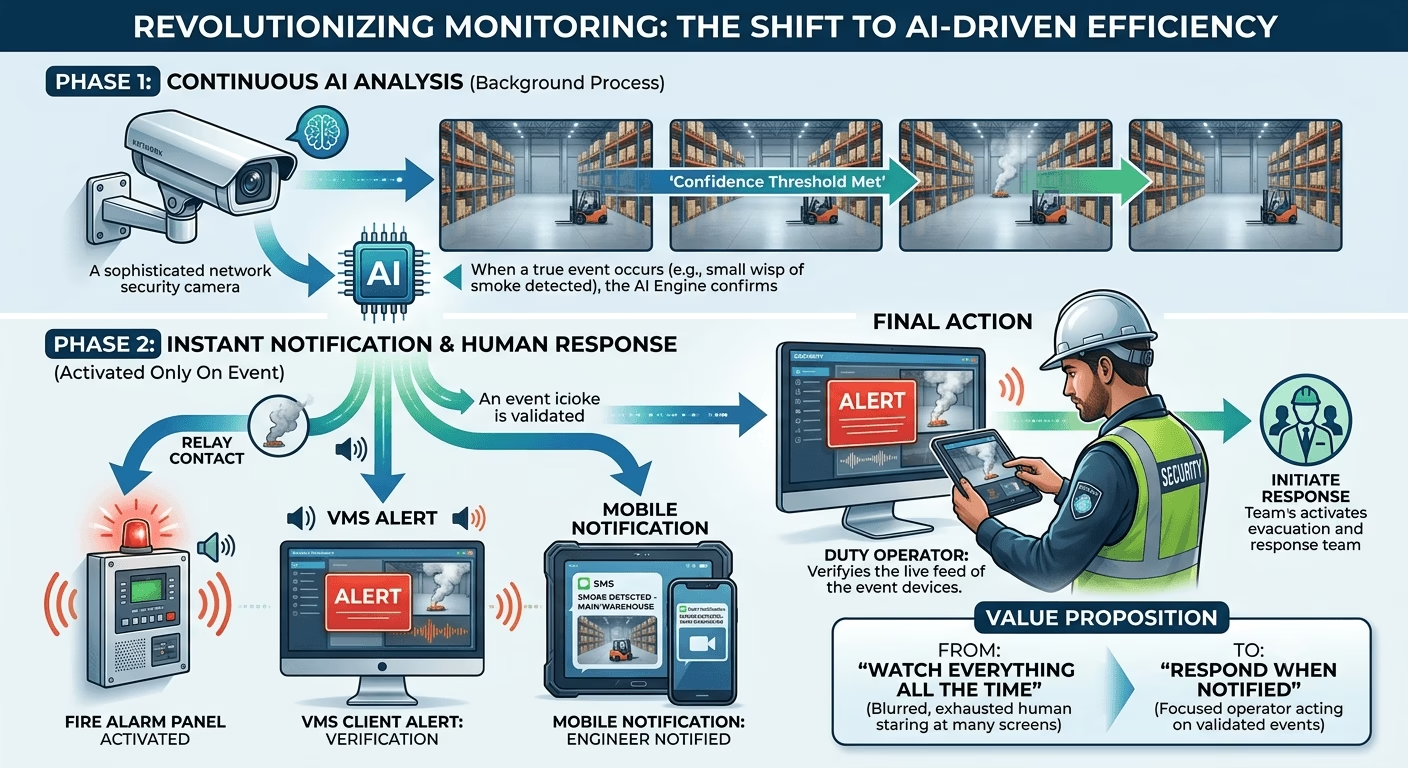
The point of building this on AI rather than a person is that the system only asks for human attention at the moment it matters. In a well-configured setup, the workflow looks like this:
- The camera or NVR analytics engine continuously scans the video stream in the background — no operator watching required.
- When the engine’s confidence threshold is met across consecutive frames, it raises an event locally, not after someone happens to notice.
- That event is pushed out through more than one channel simultaneously: a relay contact to the fire alarm panel, a pop-up and audible alert on the VMS client, and a mobile push notification or SMS to the duty engineer.
- Only at this point does a human get involved — to verify on the live feed and initiate the response procedure.
That’s the real value proposition: monitoring effort shifts from “watch everything, all the time” to “respond when notified.” It doesn’t remove the human from the loop; it removes the requirement that the human be staring at the right screen at the right second.
A Real Integration Example
Here’s a configuration I’ve used on a warehouse and logistics site with a mixed Fire nor conventional detection zone and Eyenor CCTV coverage over racking aisles and loading docks:
- AI-enabled CCTV cameras (with built-in smoke/flame analytics) cover the high-ceiling racking aisles where conventional Fire detectors have long response times.
- Camera analytics output is wired via a relay/dry-contact output into a spare zone input on the FireNor panel, so an AI-confirmed detection behaves exactly like a physical detector triggering that zone.
- In parallel, the same event is sent over ONVIF/API to the VMS rule engine, which triggers a pre-recorded PA announcement through NVS in that specific zone and pushes an alert to the site engineer’s phone.
- SecNor access control rules can optionally be tied to the same event to unlock designated fire-exit doors automatically for that zone.
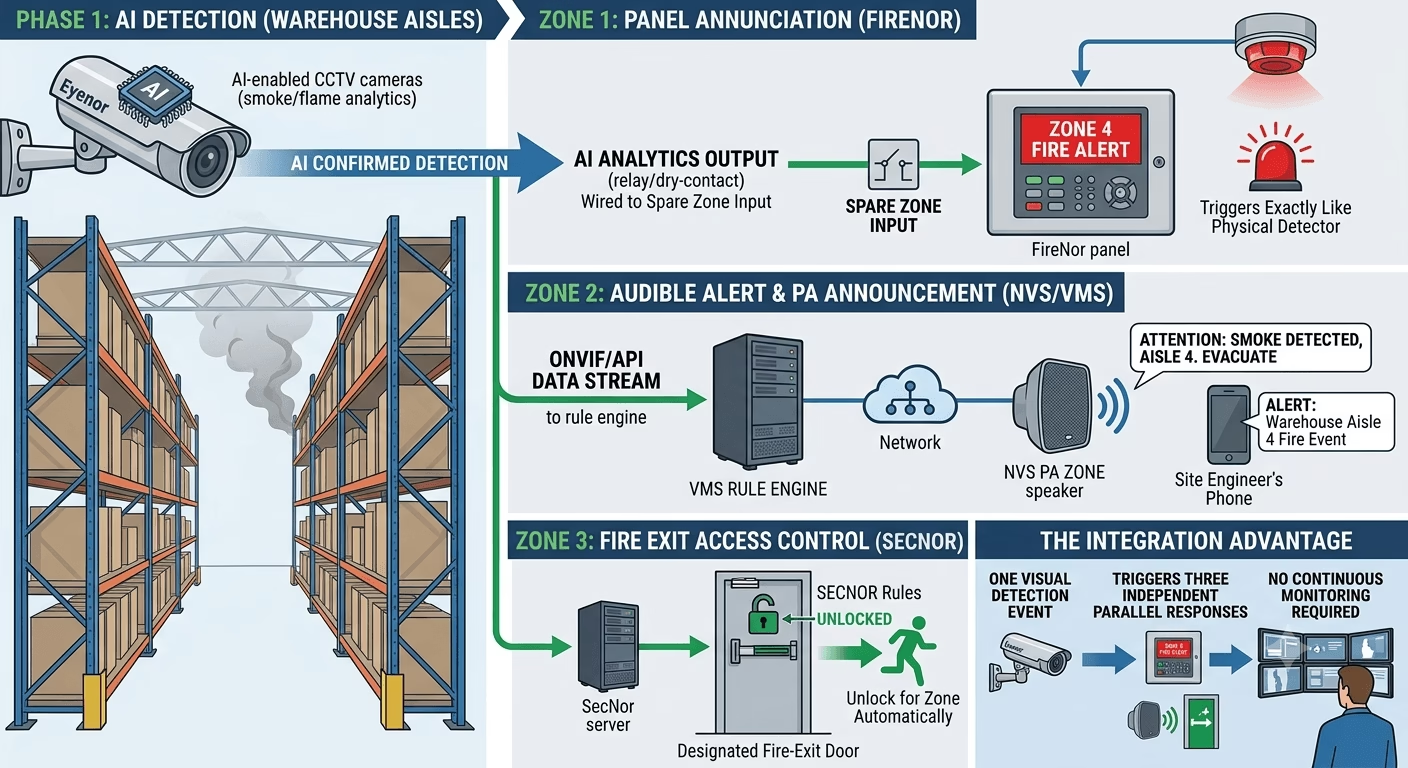
The result is one visual detection event triggering three independent, parallel responses — panel annunciation, PA announcement, and door release — without anyone having needed to be watching the monitor wall when the smoke started.
Configuration Reference
This is the baseline configuration table I start from before tuning per site. Every site still needs a burn-in period to adjust sensitivity against local conditions — dust, steam, vehicle headlights, and welding sparks are the usual culprits behind nuisance alarms.
| Parameter | Typical Setting | Engineer’s Note |
| Detection Mode | Smoke + Flame (dual) | Dual mode cuts false triggers from steam, dust, or headlights |
| Region of Interest (ROI) | Mask out sky, moving signage, vehicle lanes | Keeps the algorithm focused on the actual fire risk zone |
| Sensitivity | Medium (adjust per site after 48–72 hr burn-in) | Start conservative, tighten once nuisance alarms are logged |
| Minimum Object Size | 3–5% of frame | Filters out lighters, cigarettes, distant reflections |
| Alarm Confirmation | 2 of 3 consecutive frames | Reduces single-frame flicker or glare triggering an event |
| Output Action | Relay to FireNor zone input + VMS pop-up + push notification | Never let the camera output silently sit as an unactioned log entry |
| Schedule | 24/7 armed, higher sensitivity after hours | Unoccupied hours are exactly when “no continuous monitoring” matters most |
Where This Fits — and Where It Doesn’t
It’s worth being direct about this with clients: AI video-based fire detection is not a substitute for a UL 268 or EN 54 listed, code-compliant fire detection system. Civil Defense authorities across the GCC still require certified Fire detectors, heat detectors, or aspirating systems for life-safety compliance. What AI CCTV analytics genuinely add is speed and coverage in areas where conventional detection is physically slow or has gaps — high ceilings, open yards, loading docks, and long corridors.
The engineering approach I’d recommend, and the one used in the example above, is layered detection: keep the certified conventional or addressable system as the code-compliant backbone and add AI video analytics as an early-warning layer that shortens response time and reduces dependence on someone happening to be watching a screen at the right moment.
Closing Thoughts
Fifteen years of running ELV projects across KSA, UAE, and Qatar has taught me that most fire incidents aren’t caught late because the technology wasn’t available — they’re caught late because the monitoring model assumed continuous human attention that no control room can actually sustain. AI-based fire and smoke detection on CCTV doesn’t ask for that. It asks the cameras you’ve already paid for to do one more job, quietly, in the background, and only speak up when it matters.