
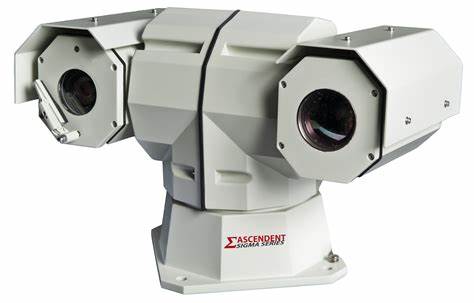
Dual-Sensor Thermal PTZ Cameras for GCC Perimeter Security- ENC-HPT7Z-50X-39
Dual-Sensor Thermal PTZ Cameras for GCC Perimeter Security
Perimeter security across the GCC faces a challenge that visible-light cameras alone cannot reliably solve: protecting long distances in darkness, dust, glare and heat haze.
A fence line spanning kilometres around a substation, desert logistics yard, coastal LNG facility or tank farm needs to detect people, vehicles and potential fire events well before they reach a critical boundary. It must operate in zero light and remain useful when dust, glare or harsh weather conditions limit conventional video surveillance.
This is where a dual-sensor thermal PTZ camera becomes valuable.
The Norden ENC-HPT7Z-50X-39 combines thermal imaging and high-zoom visible imaging in one motorised PTZ housing. It is designed for long-range detection, rapid operator response and detailed visual verification in demanding outdoor environments.
What Is a Dual-Sensor Thermal PTZ Camera?
A dual-sensor thermal PTZ camera combines two independent imaging paths:
- Thermal channel: An uncooled microbolometer sensor detects heat radiation rather than reflected visible light. This enables reliable detection in total darkness and maintains performance in glare, light fog and many low-visibility conditions.
- Visible-light channel: A high-zoom CMOS camera provides colour context and fine visual detail. Once the thermal channel detects a target, operators can use the visible camera to verify the scene, capture detailed evidence and support identification in suitable daylight conditions.
The two channels are complementary. Thermal imaging is used for early warning and reliable detection; the visible channel provides detailed context and evidential imagery once the PTZ is directed to the target.
ENC-HPT7Z-50X-39: Thermal and Visible Imaging Performance
The ENC-HPT7Z-50X-39 uses a 640 × 512 uncooled VOx thermal focal plane array. With a NETD of ≤35 mK, the sensor can resolve temperature differences as small as 0.035°C. This sensitivity helps distinguish a warm person, vehicle or fire source from a cooler desert environment, particularly at night.
Its visible-light channel uses a 1/1.8-inch 4 MP CMOS sensor with 50x optical zoom. This provides wide-area monitoring at the short end of the zoom range and detailed observation at long range.
Key imaging capabilities include: Read More
- 640 × 512 uncooled VOx thermal sensor
- ≤35 mK thermal sensitivity
- 4 MP visible CMOS sensor
- 50x optical zoom visible channel
- 25–225 mm motorised thermal lens
- 15–775 mm equivalent visible lens range
Understanding DORI: Detection Is Not Identification
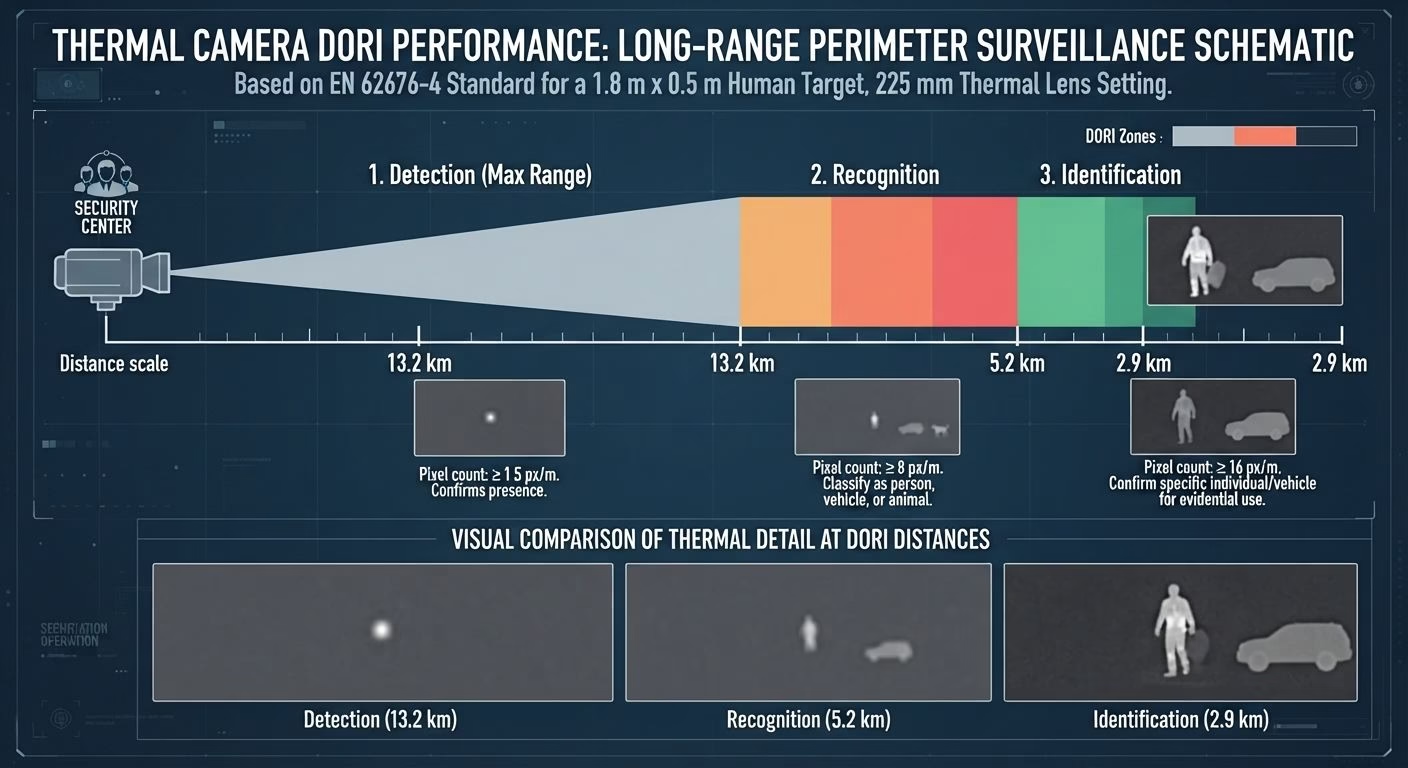
When planning perimeter surveillance, it is important to distinguish between detection, recognition and identification. DORI—Detection, Observation, Recognition and Identification—is the EN 62676-4 framework used to describe how useful a camera is at a given distance.
A long-range detection figure should not be interpreted as a long-range identification figure.
- Detection: Confirms that an object is present, such as a person crossing a fence line.
- Recognition: Provides enough detail to classify the target, for example as a person, vehicle or animal.
- Identification: Provides sufficient detail to confirm a specific person or vehicle for evidential use.
For a human target of approximately 1.8 m × 0.5 m, the thermal camera at its 225 mm long-end setting can detect an intruder at distances up to approximately 13.2 km. However, recognition is limited to approximately 5.2 km, while identification is approximately 2.9 km.
This difference is critical for design.
If the operational requirement is to identify a person before they reach a perimeter alarm zone, the system should be designed around the 2.9 km identification range—not the 13.2 km detection figure.
The visible channel can extend detailed identification in favourable daylight conditions, with a datasheet identification figure of approximately 1.07 km. This is why thermal and visible imaging should be specified together: thermal provides dependable early warning, while visible imaging provides colour and detail once the camera has been slewed to the alarm location.
Why Zoom and PTZ Preset Accuracy Matter
The visible channel’s 50x optical zoom provides a horizontal field of view from 29.1° at the wide end to 0.5° at full telephoto. At maximum zoom, the camera is effectively looking through a very narrow viewing angle.
This makes PTZ preset accuracy essential.
The ENC-HPT7Z-50X-39 offers PTZ preset accuracy of ±0.1°. At high magnification, even a small positioning error can place the target outside the field of view. Accurate presets are therefore as important as optical zoom when designing long-range identification points.
On the thermal side, the 25–225 mm motorised lens provides a horizontal field of view from 17.6° to 2.0°. Thermal imaging is optimised for temperature contrast and detection performance rather than fine visual detail, which is why pairing it with a high-zoom visible camera is the practical approach for critical perimeter projects.
Thermal Fire Detection and Perimeter Analytics
The camera’s onboard thermal analytics support more than intrusion detection. Its principal functions include:
- Thermal fire detection: Rated to detect a 1 m × 1 m fire at approximately 8–10 km and a 2 m × 2 m fire at approximately 16–20 km, depending on lens setting.
- Intrusion detection: A virtual zone that triggers when an object enters the defined area.
- Crossline or tripwire detection: Triggers when a target crosses a defined line, supporting directional rules such as alarms for inbound movement only.
Thermal fire detection is particularly relevant for landfill sites, forestry boundaries, tank farms, industrial yards and remote infrastructure. It provides a different security benefit from conventional fence-line surveillance: early warning of heat sources and fire events before they become critical.
Because these analytics operate on the thermal channel, they can support 24/7 detection without depending on visible-light performance at night.
Network and Integration Considerations
The camera provides a single RJ45 10/100M network port carrying dual H.265/H.264 video streams. It supports ONVIF, SDK integration and common network protocols including TCP/IP, RTSP, RTCP, HTTP/HTTPS, DHCP, DNS, SMTP, NTP and QoS.
For GCC deployments, the following integration points should be addressed during design:
- VLAN segmentation: VLAN configuration is applied at the network switch port, not at the camera. Confirm the correct camera VLAN before commissioning.
- RS485 serial interface: Useful for legacy PTZ keyboards, telemetry systems and analogue-to-IP migration projects.
- Alarm I/O: One alarm input and one alarm output allow direct connection to gate contacts, sirens, barriers and other field devices. This can provide a faster hard-alarm response where relying only on VMS logic is unsuitable.
A Practical Perimeter Design Approach
Consider a coastal facility in Saudi Arabia’s Eastern Province with a straight fence run and a requirement to identify anyone approaching the perimeter before they reach it.
At the 225 mm thermal setting, the identification range is approximately 2.9 km. A PTZ mounted mid-span can cover a large area over time through presets and tours, but it cannot observe every point simultaneously.
For continuous, real-time identification-grade coverage along a fence line, a dual-sensor thermal PTZ should be treated as an early-warning and slew-to-cue asset. Fixed thermal or bispectrum cameras, radar, fibre sensing or other fixed sensors provide continuous coverage, while the PTZ is directed to the alarm point for detailed visual verification and recording.
This layered architecture is generally more effective than attempting to use one PTZ as a complete continuous-coverage solution.
For tighter sites, a shorter thermal lens setting may be preferable. At approximately 150 mm, the identification range drops to around 0.8 km, but the camera can support faster response and more practical coverage for compact substations, malls, industrial yards and smaller perimeter zones.
Built for Gulf Outdoor Conditions
Three specifications are especially important for GCC field deployments:
- Operating temperature: –40°C to 75°C. This supports severe outdoor conditions, including high ambient temperatures and solar loading on unshaded poles.
- IP66 and IK10 protection. IP66 helps protect against wind-driven dust and sand; IK10 supports resistance to physical impact and vandalism.
- TVS 6000 V surge protection. This provides additional resilience against lightning-induced and switching surges on long outdoor cable runs. Proper earthing and bonding remain essential.
At 59 kg and 645 × 680.5 × 550 mm, the camera also requires careful pole and bracket selection. Mounting design must account for both static weight and wind loading while the PTZ is operating at up to 60°/s pan speed and 15°/s tilt speed.
Threshold in Thermal Camera
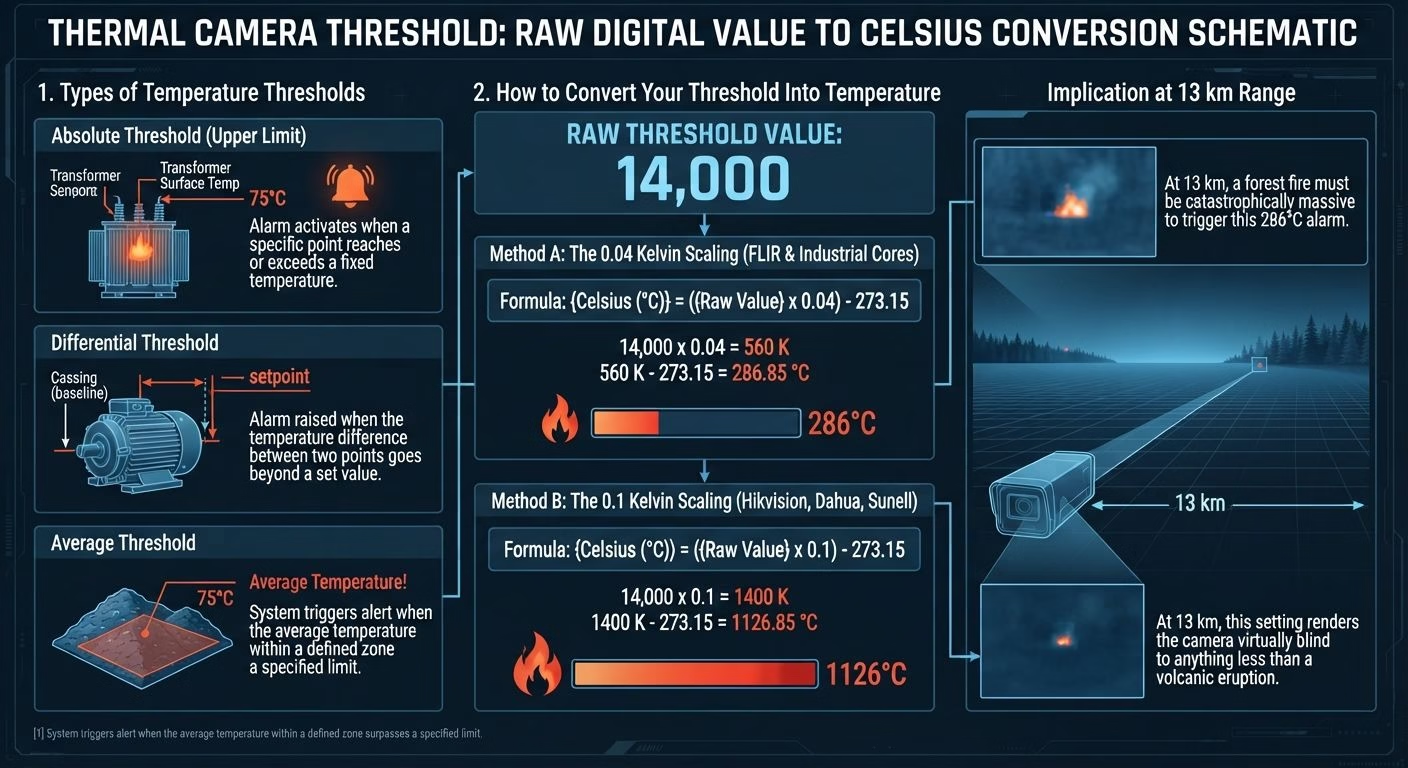
Threshold is a temperature value defined by the user within the camera’s analytics software. When the detected thermal energy of an object crosses this programmed limit, the camera automatically generates an alert.
1. Types of Temperature Thresholds
-
- Absolute Threshold (Upper or Lower Limit) An alarm activates when a specific point or area reaches or exceeds a fixed temperature.
- Example: Triggering an alert if a transformer surface temperature rises above 75°C.
- Differential Threshold An alarm is raised when the temperature difference between two points—or between a baseline and a monitored target—goes beyond a set value.
- Example: Detecting abnormal heating of a machine part compared to its normal operating temperature.
- Average Threshold The system triggers an alert when the average temperature within a defined zone or polygon surpasses a specified limit.
 2.How to Convert Your Threshold Into Temperature
-
-
Because the camera measures raw electromagnetic energy, the conversion depends entirely on whether your manufacturer calibrated the scale to Kelvin (the absolute physics standard) or a Linear Formula.
Method A: The 0.04 Kelvin Scaling (Most Common for FLIR & Industrial Cores)
Most security and long-range military sensors use a fixed factor where each raw digital number equals 0.04 Kelvin.
- Formula: {Celsius (°C)} = {Raw Value} x times 0.04) – 273.15 [1]
- Applying your 14,000 threshold:
14000 × 0.04 = 560 K
560 – 273.15 = 286.85 °C- What this means: Your current threshold of 14,000 is looking for an object that is 286°C. At a 13 km range, atmospheric cooling dilutes this signal, meaning a forest fire would have to be catastrophically massive before it triggers an alarm.
Method B: The 0.1 Kelvin Scaling (Most Common for Hikvision, Dahua & Sunell)
Many security-focused thermal cameras route raw telemetry measurements directly to a
0.1scale per digital increment to save onboard processing power.
Kelvin- Formula: {Celsius (°C)} = ({Raw Value} x 0.1) – 273.15
- Applying your 14,000 threshold:
14000 × 0.1 = 1400 K
14000 – 273.15 =1126.85°C- What this means: If your camera uses this scale, a threshold of 14,000 means it is looking for an object burning at 1,126°C. At a 13 km distance, this setting makes the camera virtually blind to anything less than a volcanic eruption.
Part 2: Best Raw Threshold Settings for 3KM, 5KM, and 8KM
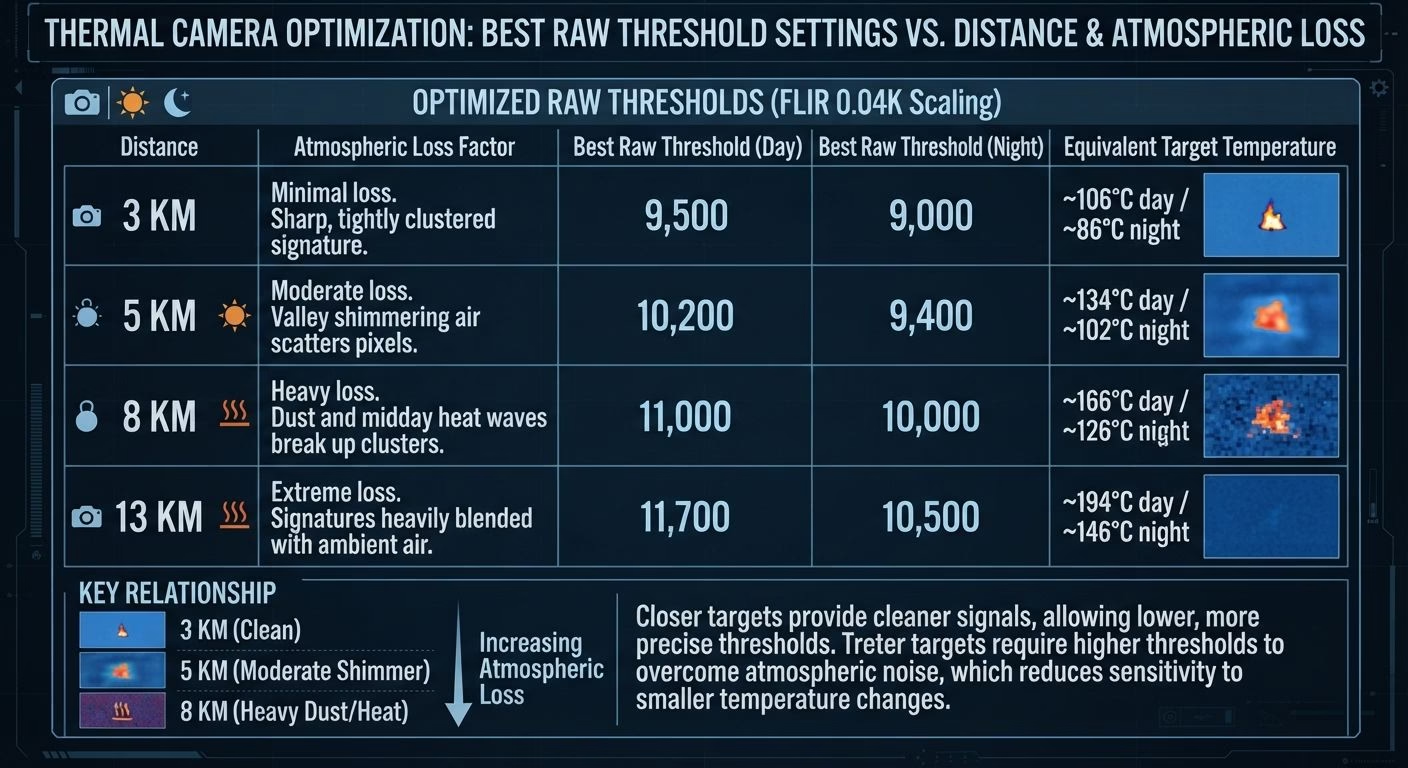
As a target gets closer to the camera, there are fewer atmospheric particles (dust, humidity, and heat shimmering) to scatter the infrared light. The camera receives a cleaner, more intense signal, allowing you to use a more precise threshold.
Assuming your camera uses the common 0.04 Kelvin scaling system, use these baseline raw thresholds to protect
Distance
Atmospheric Loss Factor
Best Raw Threshold (Day)
Best Raw Threshold (Night)
Equivalent Target Temperature
3 KM
Minimal loss. The signature is sharp and tightly clustered.
9,500
9,000
~106°C day / ~86°C night
5 KM
Moderate loss. Shimmering air from valleys begins to scatter pixels.
10,200
9,400
~134°C day / ~102°C night
8 KM
Heavy loss. Dust and midday heat waves break up pixel clusters.
11,000
10,000
~166°C day / ~126°C night
13 KM
Extreme loss. Signatures are heavily blended with ambient air pixels.
11,700
10,500
~194°C day / ~146°C night
-
Conclusion
A headline figure such as “28.8 km detection” is useful, but it is only one part of a thermal PTZ camera’s real-world performance.
Effective perimeter security design depends on matching detection, recognition and identification ranges to the operational requirement; selecting the correct lens setting; accounting for PTZ preset accuracy; and deploying the camera as part of a layered security strategy.
For large-scale GCC sites, the ENC-HPT7Z-50X-39 is best understood as a long-range thermal detection and visible verification platform—one that can support perimeter intrusion detection, thermal fire monitoring and rapid response in challenging outdoor conditions.
