Best CCTV Brands for High-Heat Environments in the Middle East (2026)
Introduction
The Middle East, a region renowned for its rapid development and ambitious infrastructure projects, presents a unique and formidable challenge for security systems: extreme heat. With ambient temperatures frequently soaring to 50-55°C (122-131°F) during the summer months across countries like Saudi Arabia, UAE, Qatar, Kuwait, Oman, and Bahrain, standard CCTV cameras are simply not built to last. As an experienced security systems engineer working across the GCC, I’ve witnessed firsthand the devastating impact of this relentless heat – from cameras suffering premature failure to, quite literally, melting off walls in the scorching Riyadh summer.
This blog post delves into the critical factors that make heat the ultimate adversary for CCTV cameras and, more importantly, guides you through selecting the best CCTV brands for high-heat environments. We’ll explore the essential technical specifications, highlight top brands and their heat-resistant models, provide practical installation tips, and share real-world examples from projects across the Middle East. Our goal is to equip you with the knowledge to deploy robust, reliable, and long-lasting surveillance solutions that can withstand the region’s harsh climate.
Why Heat is the Enemy of CCTV Cameras
To understand why specialised cameras are crucial, it’s important to grasp the technical challenges posed by extreme temperatures. The external ambient temperature is only part of the equation; direct sunlight can elevate the internal temperature of a camera housing significantly, often reaching 70-80°C (158-176°F) or even higher. This internal inferno wreaks havoc on sensitive electronic components:
•CMOS Sensor Degradation: High temperatures drastically increase thermal noise in CMOS image sensors, leading to grainy, degraded image quality, especially in low-light conditions. This compromises the camera’s primary function of clear visual capture.
•Accelerated Electronics Degradation: Components like capacitors, resistors, and integrated circuits are designed to operate within specific temperature ranges. Prolonged exposure to high heat accelerates their aging process, significantly reducing the camera’s overall lifespan. A camera designed for temperate climates might see its operational life cut by 50% or more in the Middle East.
•IR LED Failure: Infrared (IR) LEDs, vital for night vision, generate their own heat. In an already hot environment, this self-generated heat, combined with high ambient temperatures, can cause IR LEDs to burn out prematurely, rendering night surveillance ineffective.
•Housing Warping and Cracking: Many standard camera housings are made from plastics that become brittle and warp or crack under sustained high temperatures and UV exposure. This not only compromises the camera’s physical integrity but also exposes internal components to the elements.
•Seal Degradation and IP Rating Compromise: The rubber gaskets and seals that provide a camera’s Ingress Protection (IP) rating (e.g., IP66, IP67) degrade and lose elasticity in extreme heat. This leads to the ingress of dust, sand, and moisture – common in the Middle East – causing short circuits, corrosion, and catastrophic failure.
•Cable Insulation Breakdown: External cabling, if not properly rated and protected, can suffer from insulation degradation, leading to exposed wires, short circuits, and potential fire hazards.
Key Specifications to Look For (Before Choosing a Brand)
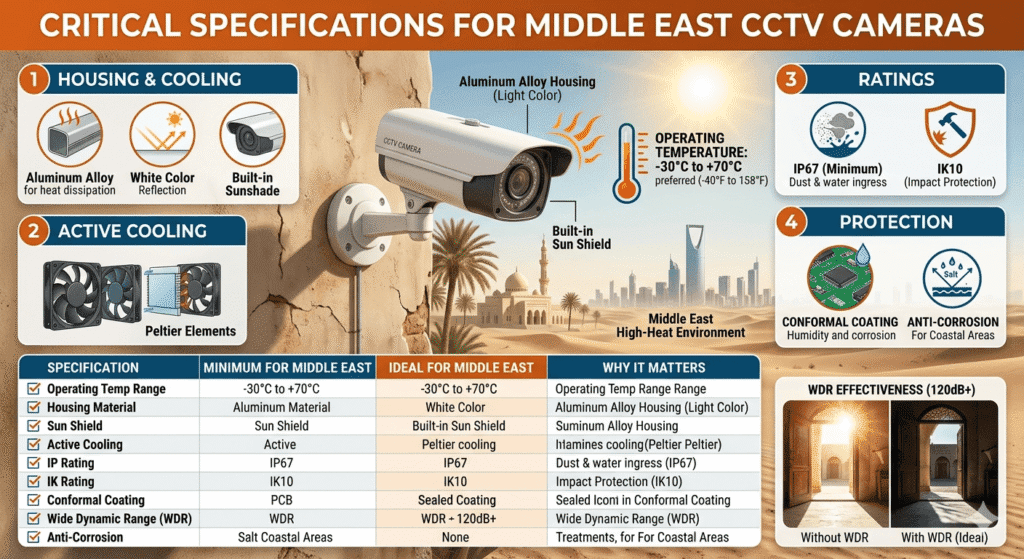
Before diving into specific brands, understanding the critical technical specifications is paramount. These are the non-negotiable features for any CCTV camera deployed in the Middle East’s high-heat environments:
1.Operating Temperature Range: This is arguably the most crucial specification. Look for cameras with a minimum operating temperature range of -30°C to +60°C. However, for true reliability and longevity in the GCC, a maximum of +70°C is strongly preferred. This provides a crucial buffer against direct sun exposure and internal heat buildup.
2.Housing Material: Avoid plastic housings at all costs. Aluminium alloy is the material of choice due to its excellent thermal conductivity (dissipating heat away from internal components) and resistance to UV degradation. White or light-colored housings are also critical, as they reflect sunlight more effectively than dark colors, reducing heat absorption.
3.Sun Shield / Sunshade: A built-in or add-on sun shield (also known as a sunshade or visor) is essential. This simple accessory provides crucial shade, preventing direct solar radiation from constantly baking the camera housing and lens, thereby significantly lowering internal temperatures.
4.Active Cooling: While less common in standard bullet or dome cameras, some high-end or specialised PTZ (Pan-Tilt-Zoom) cameras incorporate active cooling mechanisms. These can include small internal fans or even Peltier coolers (thermoelectric coolers) to actively dissipate heat from critical components. This is a premium feature but offers superior heat management.
5.IP Rating: The Ingress Protection (IP) rating indicates a camera’s resistance to dust and water. For outdoor Middle East installations, an IP67 rating is the absolute minimum. This signifies complete protection against dust ingress and resistance to immersion in water up to 1 meter for 30 minutes. Given the prevalence of sandstorms and occasional heavy rains, IP67 is non-negotiable.
6.IK Rating: The Impact Protection (IK) rating measures resistance against mechanical impacts. An IK10 rating (protection against 20 joules of impact, equivalent to a 5 kg mass dropped from 40 cm) is recommended. While primarily for vandal resistance, it also indicates a robust housing capable of withstanding thermal expansion and contraction stresses over time.
7.Conformal Coating: A thin polymeric film applied to the printed circuit board (PCB) of electronic equipment. In the Middle East, high humidity (especially in coastal areas like Jeddah, Dubai, and Doha) combined with heat can lead to condensation and corrosion. Conformal coating protects the electronics from moisture, dust, and chemical contaminants, extending lifespan.
8.Wide Dynamic Range (WDR): The intense Middle Eastern sun creates extreme contrasts between brightly lit areas and deep shadows. WDR technology (measured in dB) allows the camera to capture clear images in both bright and dark areas simultaneously, preventing silhouetting or overexposure. A WDR of at least 120dB, preferably 140 dB+, is essential for usable footage.
9.Anti-Corrosion: For installations near coastal areas or industrial zones with high salinity or chemical exposure, cameras with anti-corrosion treatments or marine-grade stainless steel housings are vital. Salt air can rapidly degrade standard metal components.
Top 7 CCTV Brands for High-Heat Middle East Environments (2026)
Based on extensive experience and market presence in the GCC, the following brands consistently deliver reliable performance in high-heat conditions:
1. Hikvision
Brand Overview: Hikvision is the world’s largest supplier of video surveillance products, with an enormous presence across the Middle East. Their extensive product range caters to almost every application and budget.
Why it’s suitable for high heat: Hikvision offers numerous models specifically designed for harsh environments, featuring robust housings, wide operating temperature ranges, and advanced thermal management.
Key Heat-Resistant Models:
•DS-2CD2xx6G2 Series: Many models in this series boast an operating temperature range of -40°C to +60°C. These are workhorses for general outdoor applications.
•DeepinView Series: These AI-powered cameras often come with enhanced environmental ratings, combining intelligent analytics with robust hardware for demanding conditions.
•Anti-Corrosion Models: Hikvision offers specialised anti-corrosion cameras (e.g., certain stainless steel models) ideal for coastal cities like Jeddah and Dubai Marina, protecting against salt spray and humidity.
Operating Temperature Range: Typically -40°C to +60°C, with some specialised models reaching higher.
Special Features for Hot Climates: Robust metal housings, integrated sun shields on many bullet cameras, and specific anti-corrosion finishes.
Price Range: Budget to Mid-range.
Where commonly used in the Middle East: Extensively used in large-scale projects, government facilities, commercial complexes, and critical infrastructure, including many Saudi Aramco facilities, where reliability is important.
Pros: Wide product range, competitive pricing, strong local support, good performance-to-cost ratio, and readily available.
Cons: Some users raise cybersecurity concerns.
2. Dahua
Brand Overview: Dahua Technology is another global leader in video surveillance, often considered Hikvision’s primary competitor. They have a strong and growing footprint in the GCC market.
Why it’s suitable for high heat: Dahua’s commitment to R&D includes developing cameras capable of operating in extreme climates.
Key Heat-Resistant Models:
•WizSense and WizMind Series: These AI-enabled series include many outdoor-rated cameras with robust build quality and extended operating temperatures up to +60°C.
•Thermal Cameras: Dahua’s thermal imaging cameras are inherently designed for harsh conditions and can be excellent for perimeter surveillance in extreme heat, as they are less affected by light and shadows.
Operating Temperature Range: Typically -30°C to +60°C for many outdoor models.
Special Features for Hot Climates: Durable metal housings; ePoE technology (extended Power over Ethernet), which is beneficial for large desert sites requiring longer cable runs without repeaters; and advanced thermal management in their higher-end units.
Price Range: Budget to Mid-range.
Where commonly used in the Middle East: Very common in UAE construction projects, commercial developments, and smart city initiatives across the GCC.
Pros: Strong AI capabilities, competitive pricing, good image quality, reliable performance, extensive product portfolio.
Cons: Similar to Hikvision, some cybersecurity concerns have been raised, though actively addressed.
3. Axis Communications (Sweden)
Brand Overview: Axis is a Swedish company renowned for its premium network video solutions. They are often considered the benchmark for quality, reliability, and innovation in the surveillance industry.
Why it’s suitable for high heat: Axis cameras are engineered for extreme environments, with many models featuring “Arctic temperature control”, which, despite the name, also ensures robust operation in high heat. Their build quality is exceptional.
Key Heat-Resistant Models:
•Axis Q-series (e.g., Q60, Q35 Series): These high-performance PTZ and fixed dome cameras are often equipped with active cooling and robust housings, offering operating temperatures up to +65°C.
•Axis P-series: Many outdoor-rated P-series cameras also provide excellent heat resistance for fixed installations.
Operating Temperature Range: -40°C to +65°C for many outdoor models.
Special Features for Hot Climates: Superior build quality (often marine-grade aluminum), advanced thermal management, active cooling in some PTZ models, and highly reliable components ensuring long-term operation in extreme conditions.
Where commonly used in the Middle East: Favoured for critical infrastructure, government projects, high-security installations, and prestigious developments like NEOM in Saudi Arabia, w
Pros: Unparalleled reliability, superior image quality, advanced analytics, excellent software integration, long lifespan, strong cybersecurity posture.
Cons: Significantly higher price point.
4. Hanwha Vision (formerly Samsung Techwin / Wisenet)
Brand Overview: Hanwha Vision, a South Korean company, is known for its high-quality, innovative surveillance solutions under the Wisenet brand. They have a strong reputation for advanced imaging technology and robust hardware.
Why it’s suitable for high heat: Hanwha cameras are built with meticulous Korean engineering, focusing on durability and performance in challenging conditions. Their Wisenet X and P series are particularly well-suited for high temperatures.
Key Heat-Resistant Models:
•Wisenet X Series: These cameras feature advanced chipsets and robust housings, with many models offering standard operating temperatures up to +55°C, and some extendable to +60°C with specific accessories or models.
•Wisenet P Series: High-resolution cameras in this series also provide excellent environmental resilience.
Operating Temperature Range: Typically -30°C to +55°C standard, with some models and accessories supporting up to +60°C.
Special Features for Hot Climates: Excellent Wide Dynamic Range (WDR) of up to 150dB, which is crucial for handling the extreme sun and shadow contrasts in the Middle East. Robust metal housings and advanced image processing to mitigate heat-induced noise.
Price Range: Mid-range to Premium.
Where commonly used in the Middle East: Popular in Qatar, particularly for World Cup infrastructure projects and other major developments, as well as commercial and government sectors across the GCC.
Pros: Exceptional image quality, industry-leading WDR, reliable hardware, strong analytics capabilities, good integration with VMS platforms.
Cons: Slightly higher price than budget.
5. Bosch Security Systems
Brand Overview: Bosch, a German multinational engineering and electronics company, brings its renowned industrial-grade quality and precision to the security sector. Bosch cameras are known for their robust construction and advanced features.
Why it’s suitable for high heat: Bosch designs its security cameras for demanding professional applications, ensuring high reliability and performance even in harsh environmental conditions, including high temperatures.
Key Heat-Resistant Models:
•AUTODOME Series: These high-speed PTZ cameras are built for outdoor use and often feature robust environmental ratings, including extended operating temperature ranges.
•FLEXIDOME Series: Many outdoor-rated fixed dome and bullet cameras in this series are designed to withstand challenging climates.
Operating Temperature Range: Typically -40°C to +60°C for outdoor models.
Special Features for Hot Climates: Robust metal housings; intelligent dynamic noise reduction (IDNR), which helps reduce image noise that can be exacerbated by heat, and a focus on long-term reliability in professional installations.
Where commonly used in the Middle East: Frequently deployed in critical infrastructure projects such as Saudi airports, metro systems, and large industrial complexes, where German engineering and reliability are highly valued.
Pros: Industrial-grade quality, excellent reliability, advanced video analytics, strong integration capabilities, robust cybersecurity.
Cons: High price point.
6. Pelco (by Motorola Solutions)
Brand Overview: Pelco, an American brand now part of Motorola Solutions, has a long history of producing heavy-duty, industrial-focused surveillance cameras. They are particularly known for their ruggedized solutions for extreme environments.
Why it’s suitable for high heat: Pelco cameras are specifically engineered for mission-critical applications in the harshest conditions, including oil & gas, refineries, and other industrial sites where extreme temperatures are common.
Key Heat-Resistant Models:
•Sarix Series: Many outdoor-rated Sarix cameras are built for durability and extended temperature operation.
•Spectra Series: Pelco’s PTZ cameras, especially those designed for outdoor use, offer robust environmental protection.
•ExSite Series: Their explosion-proof cameras are inherently designed for extreme and hazardous environments, often featuring very wide operating temperature ranges.
Operating Temperature Range: Many models offer -40°C to +65°C, with some specialised industrial models going even higher.
Special Features for Hot Climates: Heavy-duty construction, often with AISI 316L stainless steel for superior corrosion and heat resistance. Some models feature pressurised housings to prevent internal condensation and protect electronics from contaminants. Designed for continuous operation in demanding industrial settings.
Where commonly used in the Middle East: A standard choice for critical industrial facilities, particularly in the oil & gas sector, including major installations for Saudi Aramco and SABIC, where safety and uninterrupted operation are paramount.
Pros: Extremely rugged and durable, designed for hazardous and extreme environments, high reliability, specialized features like pressurised housings.
Cons: Very high price point, less focus on general commercial applications.
7. Uniview (UNV)
Brand Overview: Uniview is a rapidly growing Chinese manufacturer that has gained significant market share globally, including in the Middle East, by offering excellent value and solid performance.
Why it’s suitable for high heat: UNV has focused on improving the environmental resilience of its outdoor cameras, providing competitive operating temperature ranges and good build quality at a more accessible price point.
Key Heat-Resistant Models:
•Many of their outdoor bullet and dome cameras across various series offer operating temperatures up to +60°C.
Operating Temperature Range: Typically -30°C to +60°C for outdoor models.
Special Features for Hot Climates: Good quality metal housings, integrated sun shields on many bullet cameras, and a focus on robust design for outdoor deployment.
Where commonly used in the Middle East: gaining traction in budget-conscious projects, small to medium-sized commercial installations, and residential developments in countries like Oman and Bahrain, offering a cost-effective solution for hot climates.
Pros: Excellent value for money, good build quality for the price, growing product range, increasing market presence.
Cons: Less established brand recognition compared to Hikvision/Dahua, fewer advanced features than premium brands.
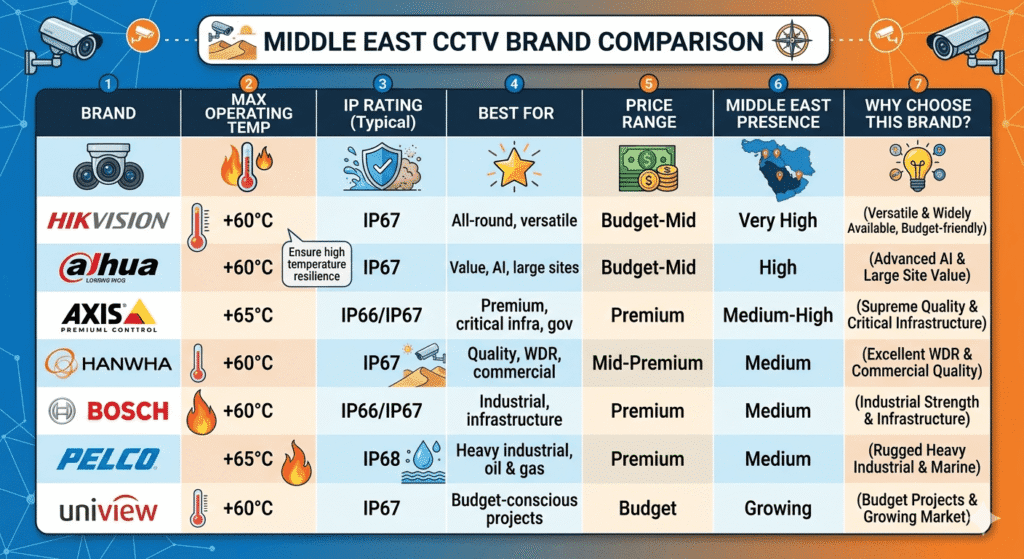
Brand Comparison Table:
Real-World Installation Tips for Middle East Heat
Even the best heat-resistant cameras can fail if not installed correctly. Here are crucial practical engineering tips honed from years of experience in the Middle East:
1.Never install cameras facing south: In the Northern Hemisphere, south-facing installations receive direct solar radiation for the longest duration, leading to maximum heat buildup. Always prioritize north-facing installations where possible to minimize direct sun exposure.
2.Always use sun shields: Even if a camera is rated for +60°C, a sun shield is not optional; it’s a necessity. It acts as a physical barrier, significantly reducing the direct solar load on the camera body and lens, thereby lowering internal temperatures and extending component life.
3.Use white/light colored housings: Black surfaces absorb up to 90% of solar radiation, converting it into heat. White or light-colored housings reflect a significant portion of this radiation, keeping the camera cooler. This seemingly minor detail can make a substantial difference.
4.Install cameras under eaves or overhangs: Whenever feasible, position cameras under existing building eaves, canopies, or other structures that provide natural shade. This offers excellent protection from direct sun and reduces ambient temperature around the camera.
5.Use ventilated pole mounts: Avoid flush wall mounts that trap heat between the camera and the wall. Ventilated pole mounts or brackets that allow for airflow around the camera housing help dissipate heat more effectively.
6.Cable management: The harsh UV radiation in the Middle East rapidly degrades standard PVC cable insulation. Always use UV-resistant conduit (e.g., rigid PVC or galvanized steel) to protect all external cabling. Ensure proper sealing at entry points to prevent dust and moisture ingress.
7.Power supply: Outdoor-rated PoE (Power over Ethernet) switches or power supplies should be housed in properly ventilated, IP-rated enclosures. Overheating power supplies can lead to system instability and failure.
8.Maintenance schedule: Sand and dust buildup is a constant challenge. Implement a rigorous maintenance schedule to clean camera lenses, housings, and sun shields every 3 months. Dust accumulation can block ventilation points and reduce the effectiveness of sun shields.
9.Night cooling: While cameras cool down at night, the daily cycle of extreme heating and cooling (thermal cycling) puts significant stress on seals, gaskets, and internal components, leading to material fatigue over time. Choosing cameras with robust materials and construction helps mitigate this.
10.Avoid south-facing walls: The surface temperature of a south-facing wall in the Middle East can easily reach 70°C (158°F) or more. Mounting cameras directly on such surfaces will transfer this extreme heat to the camera, regardless of its own rating.
Accessories That Help Cameras Survive Middle East Heat
Beyond the camera itself, several accessories can significantly enhance a system’s resilience to high temperatures:
•Sun Shields / Sunshades: As discussed, these are indispensable. They can be integrated or aftermarket add-ons made from aluminium or durable, UV-resistant plastics.
•External Cooling Fans: For extremely critical applications or cameras in exceptionally exposed locations, external, IP-rated cooling fans can be integrated into specialized housings to actively draw heat away.
•Pressurised Housings: Primarily for industrial or hazardous environments, these housings maintain a positive internal pressure, preventing the ingress of dust, moisture, and corrosive gases, while also aiding in thermal stability.
•Anti-Corrosion Spray/Coatings: For non-marine-grade metal housings in coastal areas, applying specialized anti-corrosion sprays or coatings can provide an extra layer of protection.
•UV-Resistant Cable Conduit: Essential for protecting all outdoor cabling from solar degradation.
•Ventilated Junction Boxes: All junction boxes and enclosures for power supplies or cable terminations should be IP-rated and designed with ventilation to prevent heat buildup.
•Thermal Paste Reapplication: During major maintenance cycles, especially for high-performance cameras, reapplying high-quality thermal paste to the CPU/GPU of the camera’s internal board can improve heat transfer to the housing.
What NOT to Buy for the Middle East (Common Mistakes)
Avoiding common pitfalls is as important as choosing the right equipment. Here are critical mistakes to steer clear of:
•Plastic Housing Cameras: These will invariably warp, crack, and fail prematurely due to UV degradation and thermal stress. Their seals will also degrade rapidly.
Cameras Rated Only to +50°C: While 50°C might seem adequate for ambient temperatures, it leaves no margin for direct sun exposure or internal heat buildup. Always aim for +60°C or, ideally, +70°C.
•Indoor Cameras Used Outdoors: Even for “temporary” outdoor use, indoor cameras lack the necessary IP rating, robust housing, and temperature resilience for the Middle East climate. They will fail quickly.
•Cheap No-Brand Cameras Without Proper IP Rating: The market is flooded with inexpensive cameras lacking verifiable specifications. Without a certified IP67 (or higher) rating, these cameras are a gamble and will almost certainly succumb to dust and moisture.
•Cameras Without WDR: Without Wide Dynamic Range, your footage will be plagued by severe overexposure in bright areas and underexposure in shadows, rendering critical details invisible during much of the day.
FAQ Section
Q: What temperature can CCTV cameras withstand?
A: Standard outdoor CCTV cameras typically withstand temperatures up to +50°C. However, for the Middle East’s extreme heat, you should look for cameras rated for at least +60°C, with +70°C being ideal for prolonged reliability under direct sun
Q: Can CCTV cameras work in 50-degree heat?
A: Yes, many outdoor-rated CCTV cameras are designed to operate in 50°C ambient temperatures. However, it’s crucial to consider that direct sunlight can push the internal temperature much higher. Cameras rated for +60°C or more, combined with proper sun shielding, are recommended for sustained operation in 50°C ambient heat.
Q: Which CCTV brand is best for Saudi Arabia?
A: For Saudi Arabia, brands like Hikvision and Dahua offer excellent value and widespread availability for general projects. For critical infrastructure, government, or industrial applications, premium brands like Axis Communications, Bosch, and Pelco are often preferred due to their superior build quality and extreme environment ratings.
Q: Do I need special cameras for desert environments?
A: Absolutely. Desert environments combine extreme heat, intense UV radiation, and fine dust/sand. You need cameras with extended operating temperature ranges (+60°C or higher), robust aluminum housings, IP67/IP68 ratings for dust and water, and strong WDR capabilities.
Q: How do I protect CCTV cameras from sandstorms?
A: Protection from sandstorms primarily comes from a high IP rating (IP67 or IP68) to prevent dust ingress. Robust metal housings (IK10 rated) also protect against physical abrasion from wind-blown sand. Regular cleaning after sandstorms is also crucial.
Q: What is the lifespan of outdoor cameras in the Middle East?
A: With standard cameras, the lifespan can be drastically reduced to 1-2 years. However, with properly selected heat-resistant cameras and correct installation practices, you can expect a lifespan of 5-7 years or even longer, similar to temperate climates.
Q: Is Hikvision or Dahua better for hot weather?
A: Both Hikvision and Dahua have a range of outdoor cameras suitable for hot weather, with many models rated for up to +60°C.
Q: Do cameras need shade in the Middle East?
A: Cameras definitely need shade in the Middle East. A camera may be rated for high temperatures, but shade from a sun shield and strategic placement greatly reduce thermal load, extend the camera’s lifespan and improve long-term reliability.
Conclusion
Deploying effective CCTV surveillance in the high-heat environments of the Middle East involves more than just selecting a camera; it requires a comprehensive strategy to tackle unique climatic challenges. Focus on cameras with extended temperature ranges, durable metal housings, high IP and IK ratings, and features like Wide Dynamic Range (WDR) and conformal coating for a robust security system. Brands like Hikvision and Dahua offer excellent value, while Axis, Hanwha, Bosch, and Pelco provide premium solutions for demanding applications. Proper installation practices—such as strategic positioning, sun shields, and UV-resistant cabling—are equally important. Investing in heat-resistant CCTV solutions upfront can save on maintenance, replacements, and security breaches, ensuring your surveillance infrastructure effectively protects your assets for years.