
Introduction — Why Standards Matter More Than You Think
Here is a question I get asked regularly on project sites across the GCC: which standard are we following on this job, BS 5839 or NFPA 72? And surprisingly often, the answer from the consultant is “both.”
That answer is not wrong — but it is incomplete. If you are designing or commissioning fire alarm systems in Saudi Arabia, the UAE, Qatar, or Bahrain, you will encounter both of these standards on the same project. The client might specify BS 5839 because they are a British-managed facility. The local Civil Defence authority references NFPA 72. The fire consultant writes a spec that cherry-picks from both. And you, as the engineer or project manager, are expected to make it all work.
The good news is that both standards share the same fundamental goal: to detect fire early, alert occupants reliably, and minimize loss of life and property. The engineering logic is the same. But the terminology, the classification systems, the testing requirements, and the documentation differ enough that mixing them up during design or commissioning creates real problems—non-compliance findings, rework, and delays to project handover.
This article gives you a clear, field-tested breakdown of both standards—so you can read a project spec, identify which requirement comes from where, and design a compliant system with confidence.
| GCC Context
In Saudi Arabia, the Saudi Building Code (SBC 801) and General Directorate of Civil Defence (GDCD) requirements primarily reference NFPA 72 and NFPA 101. However, many private sector, healthcare, and airport projects also specify BS 5839-1. Always confirm the applicable standard with both the consultant and the local civil defence or municipality at the design stage. |
Who Publishes These Standards and Why
BS 5839-1 — British Standard for Fire Detection and Alarm Systems
BS 5839 is published by the British Standards Institution (BSI) and covers fire detection and fire alarm systems for buildings. Part 1 specifically deals with the code of practice for the design, installation, commissioning, and maintenance of systems in non-domestic premises.
The standard has been in use since the 1980s and has gone through multiple revisions. The most recent major edition is BS 5839-1:2017 (with a 2025 amendment that tightened requirements on false alarm management and wireless system performance). It is the dominant standard in the UK, and by extension, in GCC countries that adopted British engineering codes, which include most of the early infrastructure development in Saudi Arabia, UAE, and Bahrain.
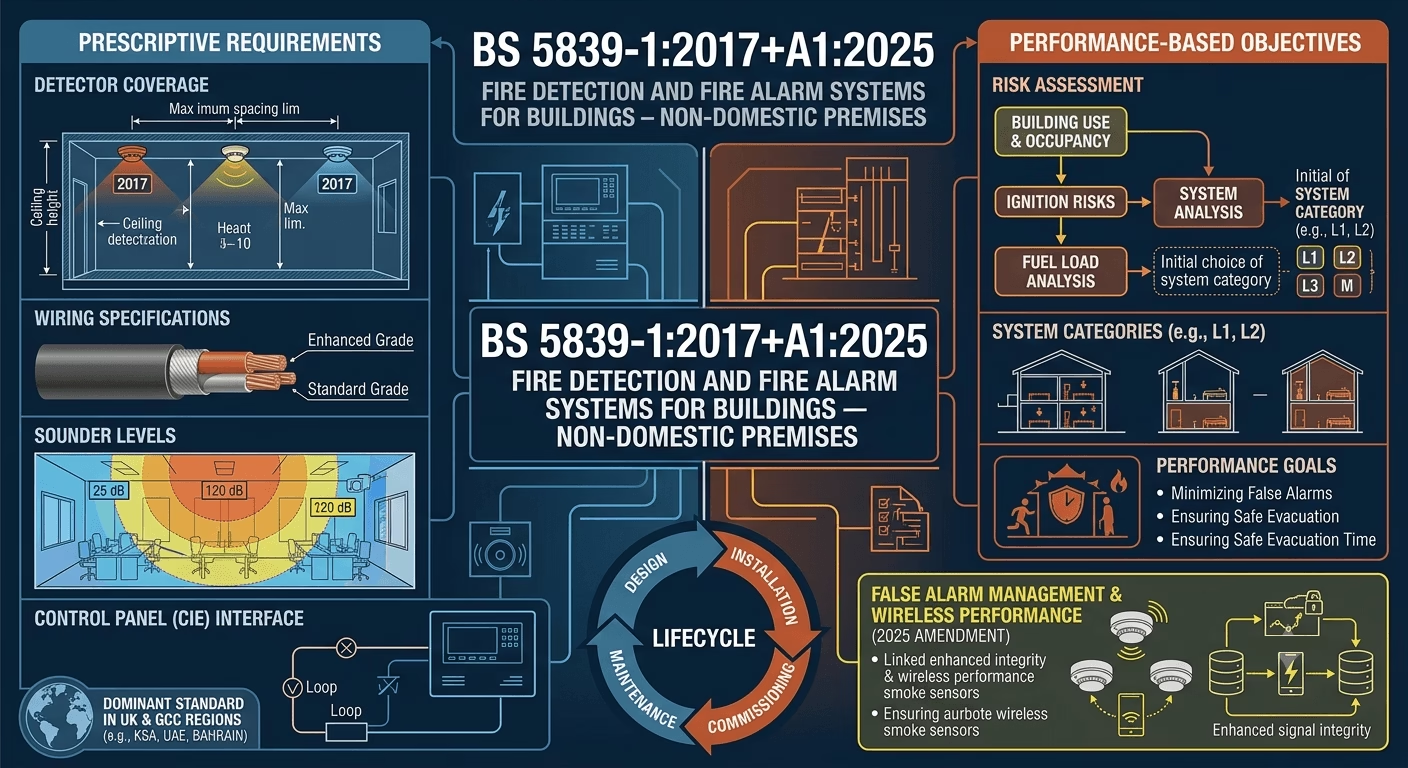
BS 5839 is a prescriptive and performance-based hybrid. It defines what the system must achieve and provides detailed guidance on how to achieve it. It is also unusually specific about design philosophy — for example, it explicitly requires a documented risk assessment before system category selection, which many other standards do not mandate.
NFPA 72 — National Fire Alarm and Signalling Code
NFPA 72 is published by the National Fire Protection Association and is the primary fire alarm standard in the United States. It covers system design, installation, inspection, testing, and maintenance of fire alarm and emergency communication systems.
Unlike BS 5839, NFPA 72 works in close conjunction with NFPA 101 (Life Safety Code) and local building codes. The Authority Having Jurisdiction (AHJ) — typically the local fire department or building authority — has significant discretionary power in how NFPA 72 requirements are applied on any given project. This means that what is technically compliant under NFPA 72 might still be rejected by the local AHJ if it does not meet their specific interpretations or amendments.
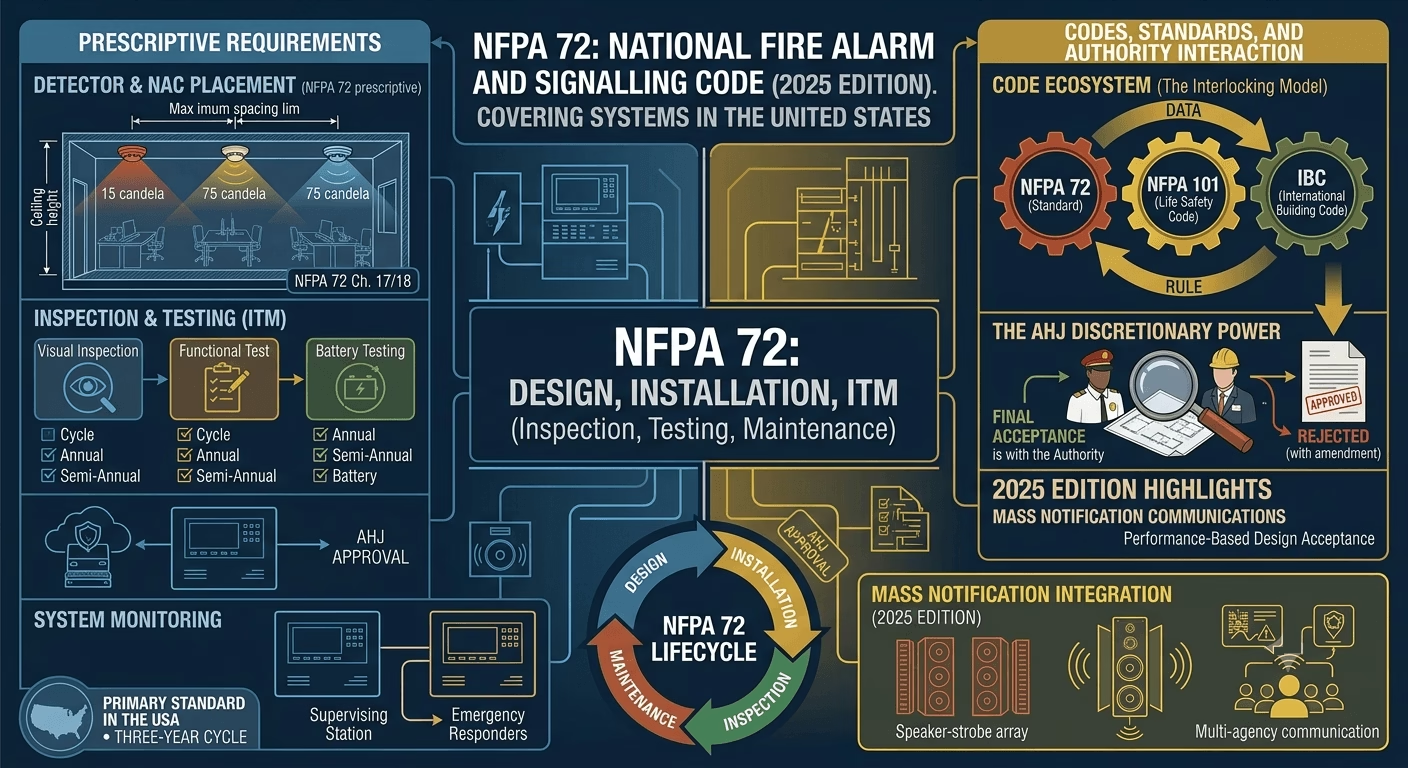
NFPA 72 is updated on a three-year revision cycle. The 2025 edition is the current version. Key differences in recent editions include enhanced requirements for mass notification systems, emergency communications, and performance-based design acceptance criteria.
| Key Difference #1
BS 5839 is a single, self-contained standard. NFPA 72 is one piece of a larger regulatory framework that includes NFPA 101, local building codes, and AHJ interpretations. Compliance with NFPA 72 alone does not guarantee project approval in NFPA-governed jurisdictions. |
System Categories and Coverage Philosophy
BS 5839-1 — Defined Category System
One of the most practically useful features of BS 5839-1 is its formal category system. Before you design a single zone or place a single detector, the standard requires you to define what the system is intended to achieve. The categories are split into two streams: L (Life Protection) and P (Property Protection).
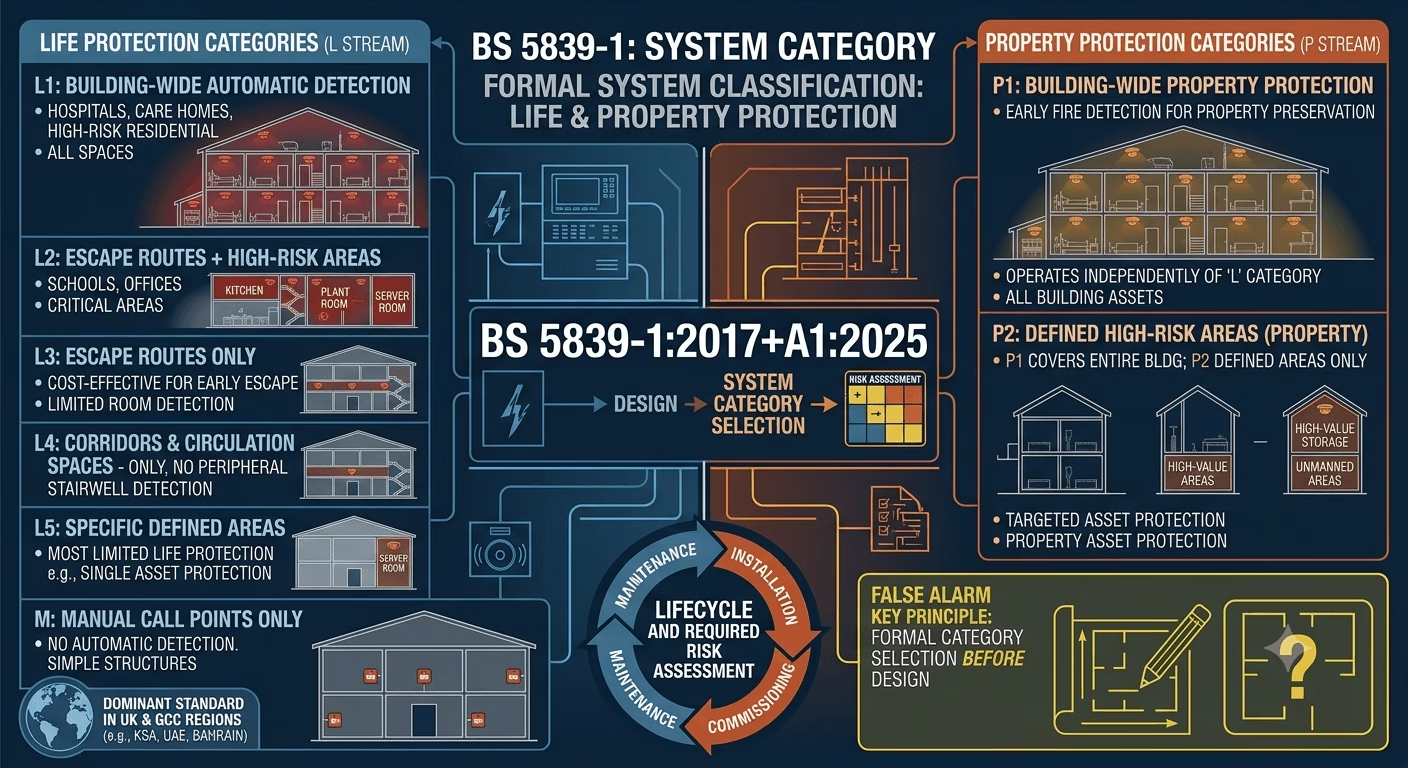
The L categories define how much of the building receives automatic fire detection, based on the level of life safety protection required. Here is how they break down in practice:
- L1 — Automatic detectors throughout the entire building, including roof voids, floor voids, and all hidden spaces. This is the highest level and is typically specified for hospitals, care homes, and high-risk residential.
- L2 — Automatic detection in escape routes plus areas of high fire risk (e.g. kitchens, plant rooms, and server rooms). Common in schools, offices, and commercial buildings.
- L3 — Automatic detection on escape routes only. A cost-effective solution for buildings where early warning on the means of escape is the primary goal.
- L4 — Detection in corridors and circulation spaces only. Provides a warning but limited early detection in the room of origin.
- L5 — Detection in specifically defined areas only, such as a single server room or archive. The most limited life protection category.
- M — Manual call points only, no automatic detection. Acceptable only for very simple, low-risk, or temporary structures.
- P1/P2 — Property protection categories that operate independently of the L categories. P1 covers the entire building; P2 covers defined high-risk areas only.
NFPA 72 — Occupancy-Based Approach
NFPA 72 does not use the same formal category system as BS 5839. Instead, the system design is driven by occupancy classification under NFPA 101 (Life Safety Code) and the specific requirements attached to each occupancy type. A hospital has different requirements to a hotel, which differs from an industrial facility — and those requirements are defined in NFPA 101 with NFPA 72 providing the technical means of compliance.
This approach gives more flexibility but requires the engineer to cross-reference multiple documents to establish what the system must do. For engineers more familiar with BS 5839’s self-contained structure, this can initially feel fragmented.
The table below maps BS 5839 categories to their approximate NFPA 72 equivalents to help during multi-standard project design:
| BS 5839 Category | Definition | NFPA 72 Equivalent Approach |
| L1 | Full automatic detection throughout the building | Automatic sprinkler-triggered alarm + detectors in all areas |
| L2 | Detection in escape routes + high-risk areas | Detectors in corridors, stairwells, and defined areas |
| L3 | Detection in escape routes only | Smoke detection on egress paths only |
| L4 | Detection in corridors/circulation spaces only | Limited detection; partial coverage |
| L5 | Specific local protection only (e.g. server room) | Suppression-linked alarm; occupant-specific protection |
| M | Manual call points only; no automatic detection | Manual fire alarm system per NFPA 72 Chapter 23 |
| P1 | Full property protection (automatic) | Property protection per AHJ requirements |
| P2 | Partial property protection | Partial automatic detection; defined areas only |
| ⚠ Important Note on Category Mapping
The mapping above is a practical approximation for field use. BS 5839 categories and NFPA 72 occupancy requirements are not formally interchangeable. On any project where both standards apply, seek written confirmation from the consultant and fire authority on which standard governs each specific requirement. |
Wiring and Circuit Classifications
This is one of the areas where the two standards diverge most significantly in terminology — but align closely in engineering intent. Engineers switching between BS 5839 and NFPA 72 projects often get confused here, so it is worth understanding both systems clearly.
BS 5839-1 Wiring Types
BS 5839-1 uses a simple two-tier classification for signalling circuits on addressable systems:
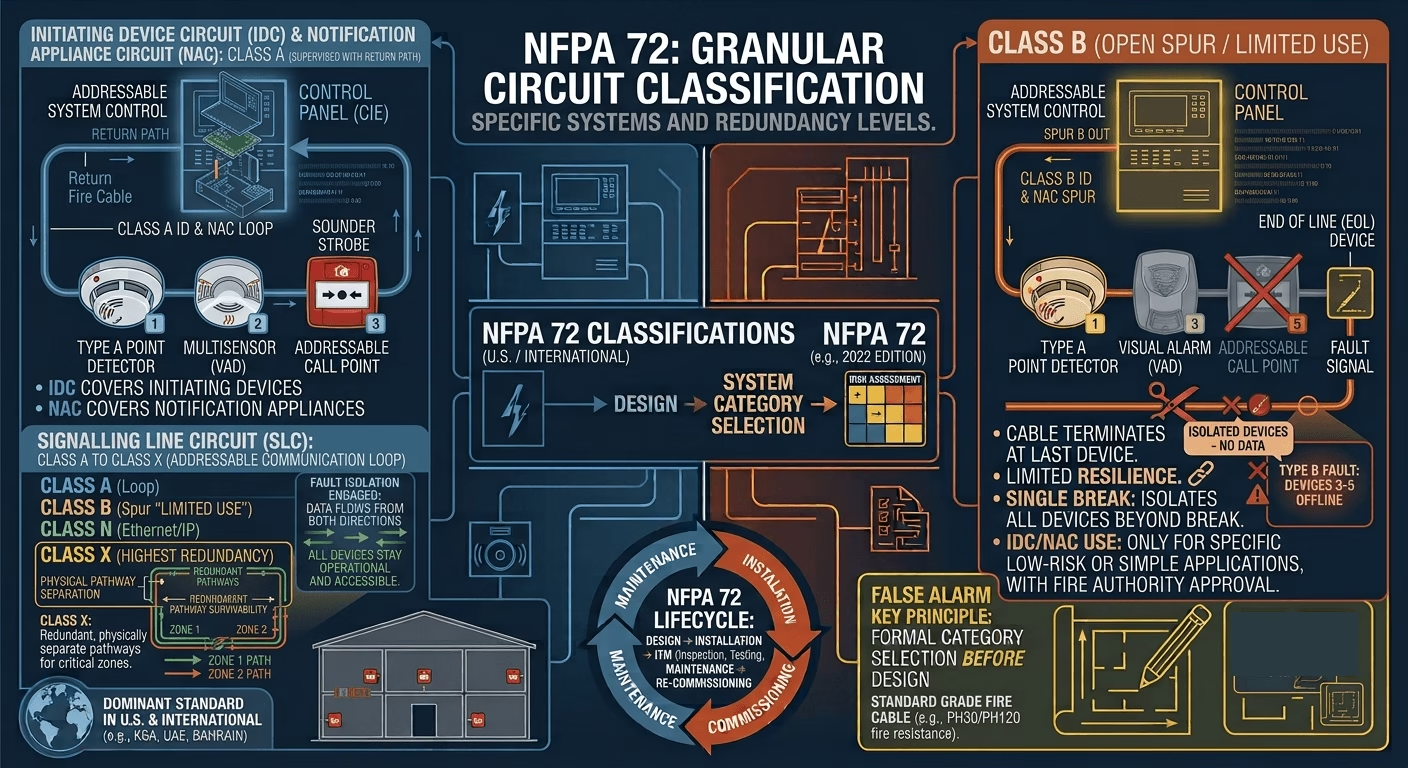
Type A (Closed Loop): The signal cable leaves the panel, connects all devices in the loop, and returns to the panel from the opposite direction. If the cable is cut at any single point, all devices on both sides of the break remain powered and operational. This is the most resilient configuration and is recommended for all large or high-risk installations.
Type B (Open-End / Spur): The signal cable leaves the panel and terminates at the last device without returning. A single cable break can isolate all devices beyond that point. Acceptable for smaller, lower-risk installations where cost is a significant constraint, but should be discussed and agreed with the fire authority.
NFPA 72 Circuit Classifications
NFPA 72 uses a more granular classification system, applied separately to different circuit types:
Initiating Device Circuit (IDC): The circuit connecting detectors and manual call points to the panel. Classified as Class A (supervised with return path, equivalent to BS 5839 Type A) or Class B (open-end, equivalent to Type B).
Notification Appliance Circuit (NAC): The circuit powering sounders, strobes, and speakers. Also Class A or Class B. Class A NAC wiring is increasingly required in high-rise and institutional occupancies.
Signalling Line Circuit (SLC): The addressable communication loop — equivalent to the signalling circuit in BS 5839 addressable systems. NFPA 72 defines Class A through Class X configurations for SLC, with Class X providing the highest level of redundancy through physical pathway separation.
| Practical Tip
When you are writing a fire alarm specification for a GCC project that references both standards, map the BS 5839 Type A/B wiring requirement to NFPA 72 Class A/B to avoid conflicting requirements. They mean the same thing in practice — just written differently. Noting both in your design drawings prevents confusion during Civil Defence inspection. |
Detector Spacing and Placement Rules
Detector spacing is one of the most frequently referenced topics during design reviews and site inspections. Both standards provide clear rules, but the numbers differ — and those differences matter when you are laying out a reflected ceiling plan.
BS 5839-1 Spacing Rules
For standard ceiling heights up to 6.0m, BS 5839-1 specifies the following for point detectors:
- Smoke detectors: maximum coverage radius of 7.5m from detector centre. On a flat ceiling, this gives approximately 176m² per detector.
- Heat detectors: maximum coverage radius of 5.3m from detector centre. Approximately 88m² per detector.
- Maximum distance between any smoke detector and a wall: 7.5m. Maximum distance between detectors: 10.6m on a flat ceiling.
- In corridors wider than 2m, detectors should be spaced at no more than 15m apart along the length.
For ceiling heights above 6m, reduced coverage radii apply. Atria, warehouses, and large open spaces above 12m typically require beam detectors or aspirating smoke detection (ASD) systems.
NFPA 72 Spacing Rules
NFPA 72 Chapter 17 defines detector spacing using listed spacing values published by the detector manufacturer (based on UL 268 or UL 521 listing), with guidance values as follows:
- Smoke detectors: 9.14m (30 ft) radius from detector centre on smooth flat ceilings. This gives approximately 264m² per detector — a noticeably larger coverage area than BS 5839.
- Heat detectors: 6.4m (21 ft) radius on smooth flat ceilings. Approximately 129m² per detector.
- Reductions apply for beamed ceilings, sloped ceilings, and high-air-movement environments.
| ⚠ Do Not Mix Spacing Values
A common mistake on dual-standard projects is applying BS 5839 spacing rules to a project that is actually governed by NFPA 72, or vice versa. The NFPA 72 smoke detector radius of 9.14m is significantly larger than the BS 5839 radius of 7.5m. Using the NFPA value on a BS 5839 project means under-coverage. Confirm which standard governs detector placement before finalising your reflected ceiling plan. |
Acceptance Testing and Commissioning Requirements
Both standards mandate formal acceptance testing before a system is handed over — but the structure, documentation, and third-party involvement requirements differ significantly.
BS 5839-1 Commissioning — Clause 57
BS 5839-1 Clause 57 defines the commissioning and acceptance test requirements. Every installed device must be tested individually and the result recorded. The commissioning engineer signs a Certificate of Completion confirming the system has been installed and tested in compliance with the standard.
For Category L3 systems and above in high-risk occupancies (e.g. hospitals, residential care facilities), BS 5839-1 recommends third-party certification through a UKAS-accredited body such as BAFE (SP203 scheme). In the GCC, Saudi Aramco and many government healthcare clients require an equivalent third-party commissioning witness.
Key commissioning documentation under BS 5839-1 includes:
- Certificate of Completion (BS 5839-1 Annex F format)
- As-fitted drawings with device locations, zone assignments, and cable routes
- Panel configuration printout or backup file
- Cause-and-effect matrix (reviewed and signed off by consultant)
- Battery calculation confirming 24-hour standby plus 30-minute alarm duration
- Alarm sounder level measurements (minimum 65 dB(A) or 5 dB(A) above ambient noise)
- Record of any deviations from the original design, with written justification
NFPA 72 Acceptance Testing — Chapter 14
NFPA 72 Chapter 14 defines a comprehensive inspection and testing regime. Unlike BS 5839, NFPA 72 explicitly requires the involvement of the Authority Having Jurisdiction (AHJ) in the acceptance process. The AHJ — typically the local fire department or municipality — reviews the Record of Completion form and may conduct a witnessed test of selected devices.
NFPA 72 requires a completed Record of Completion (Chapter 7, Figure 7.8.2) that documents every aspect of the installed system including software version, battery calculations, remote monitoring details, and the list of devices tested.
NFPA 72 also defines an annual inspection and testing schedule in Table 14.3.1, which specifies test frequencies for every component type — a useful reference when writing an O&M maintenance schedule for the client.
| Field Note
In my experience on GCC projects, Civil Defence inspectors during final inspection often ask specifically for the commissioning test sheets signed by the engineer. Having a clean, device-by-device test record — whether BS 5839-1 format or NFPA 72 Record of Completion format — is the single most important document at handover. Projects that present disorganised or incomplete commissioning records almost always face delay and re-inspection. |
Step-by-Step: Navigating a Dual-Standard Project (BS 5839 + NFPA 72)
If you are working on a project in the GCC where both standards are referenced, here is a practical workflow I have developed over years of handling exactly this situation:
Step 1 — Read the Specification Carefully
Most project specifications list the applicable standards in the general conditions or the fire alarm section preamble. Identify which standard governs which aspect of the design. Common split: BS 5839 for system category and design philosophy; NFPA 72 for wiring class, testing, and Civil Defence acceptance. Write this down and confirm it with the consultant in writing.
Step 2 — Establish the BS 5839 System Category
Use the risk assessment (or the category stated in the specification) to define the system category (L1 through L5, M, P1, P2). This determines coverage extent and drives your zone layout and device placement plan.
Step 3 — Apply the Correct Detector Spacing Standard
Confirm with the consultant which spacing rules apply to your reflected ceiling plan. If BS 5839-1 governs detector placement, use the 7.5m smoke / 5.3m heat radius values. If NFPA 72 governs, use 9.14m / 6.4m. Mark this on your drawings so it is clear during inspection.
Step 4 — Define Wiring Class in Both Terminologies
Label your wiring diagrams with both BS 5839 and NFPA 72 terminology. For example: “Signalling Loop: BS 5839 Type A / NFPA 72 Class A SLC.” This removes ambiguity for both the consultant and the Civil Defence inspector.
Step 5 — Program Cause-and-Effect to Meet Both Standards
Both standards require that the cause-and-effect logic is formally documented. BS 5839 calls it a cause-and-effect matrix; NFPA 72 refers to it in the context of the system operational program. Either way, get it reviewed and signed off before commissioning begins.
Step 6 — Prepare Two Commissioning Documentation Sets if Required
Some Civil Defence authorities in KSA and UAE require NFPA 72 Record of Completion format specifically. Others accept BS 5839 Certificate of Completion format. Prepare both if there is any ambiguity. The content is essentially the same; it is the formatting and field names that differ.
Step 7 — Engage Civil Defence Early for Pre-Approval
For large or complex projects (hospitals, high-rises, airports), submit your fire alarm design drawings and specification to the local Civil Defence or municipality for pre-approval before installation begins. This avoids the situation where a non-compliance finding during final inspection requires rework on an already-installed system.
Step 8 — Conduct Witnessed Acceptance Test
Test every device individually and record results. For NFPA 72 projects, notify the AHJ at least 10 working days in advance of the final acceptance test. For BS 5839 high-risk occupancies, arrange third-party witness commissioning if required. Ensure the client representative or consultant signs the test completion certificate on the day.
Full Standards Comparison Reference Table
The table below serves as a quick-reference guide covering all key parameters across both standards:
| Aspect | BS 5839-1 (UK/GCC) | NFPA 72 (US/International) |
| Governing Body | BSI (British Standards Institution) | NFPA (National Fire Protection Assoc.) |
| Primary Market | UK, GCC, East Africa, South Asia | USA, Middle East, Latin America, Asia |
| System Categories | L1–L5 (Life), M (Manual), P1–P2 (Property) | No formal category structure; uses occupancy-based approach |
| Wiring Class | Type A (loop), Type B (spur/radial) | Class A, Class B, Class C, Class D, Class E, Class X (SLC/IDC/NAC) |
| Zone Size Limit | Max 2,000 m² per zone; max 1 floor per zone | No fixed area limit; based on travel distance and detector spacing |
| Detector Spacing | 7.5 m radius (point smoke); 5.3 m radius (heat) | 9.1 m radius (30 ft) for smoke; 6.4 m radius (21 ft) for heat |
| Cable Requirement | Fire-rated; LSZH recommended; CI/MICC for high-risk | CI (Circuit Integrity) rated; FPL/FPLR/FPLP classifications |
| Acceptance Testing | Clause 57 commissioning; L3 or above requires third-party | Chapter 14 acceptance testing; AHJ (Authority Having Jurisdiction) approval |
| Maintenance | Annual BS 5839-1 service; quarterly log checks | Chapter 14 Table 14.3 inspection/testing frequency schedule |
| False Alarm Guidance | Annex C: CFO (Cause for Concern), unwanted alarm policy | No equivalent formal unwanted alarm framework in NFPA 72 itself |
| Documentation | Certificate of Completion, O&M manual, as-built drawings | Record of Completion Form (NFPA 72 Chapter 7), system record |
Ongoing Maintenance Requirements
BS 5839-1 Maintenance Schedule
BS 5839-1 Clause 45 specifies minimum maintenance requirements. In practice, the standard is followed through a service contract. Key frequencies:
- Weekly: Visual check of panel for fault or alarm indication; log checked and signed
- Quarterly: Functional test of a sample of detectors (rotating so all devices are tested over a 12-month cycle); battery voltage check; sounder test
- Annually: Full system test by competent person; all detectors tested; panel inspected; backup battery load test; cause-and-effect verified; service report issued
NFPA 72 Inspection and Testing (Table 14.3.1)
NFPA 72 Table 14.3.1 is one of the most comprehensive maintenance reference tables in any fire alarm standard. It lists every system component and specifies whether it should be inspected visually, tested functionally, or both, and at what frequency. Key intervals:
- Monthly: Visual inspection of panel and notification appliances; check for trouble signals
- Semi-Annually: Functional test of smoke detectors in high-air-movement environments
- Annually: Full functional test of all initiating devices, notification appliances, and control panel functions; battery replacement per manufacturer recommendation (typically every 3–4 years)
| Maintenance Tip
One practical advantage of NFPA 72 Table 14.3.1 is that it gives you a ready-made framework for writing the Planned Preventive Maintenance (PPM) schedule in your O&M manual. Map the table directly to your system components and hand it to the client as their annual service checklist. It saves time and sets professional expectations for what maintenance actually involves. |
False Alarm Management — Where the Standards Diverge
False alarms are one of the most operationally damaging problems in fire alarm systems. They erode confidence, lead building occupants to ignore real alarms, and result in unnecessary emergency service callouts. The two standards handle this differently.
BS 5839-1 Annex C — Unwanted Alarm Management
BS 5839-1 dedicates a significant annex specifically to the management of unwanted alarms. The standard defines a formal process: if a system generates more than a defined number of unwanted alarms within a 12-month period, the responsible person must take documented steps to identify and address the root cause. The standard provides a hierarchy of investigation and remediation measures, from detector sensitivity adjustment through to detector relocation or type change.
This framework is particularly useful in occupied buildings where the facilities team may be under pressure to simply isolate nuisance detectors rather than properly investigate the cause. BS 5839-1 gives the engineer a documented standard to reference when pushing back on that approach.
NFPA 72 Approach to Unwanted Alarms
NFPA 72 does not contain an equivalent dedicated unwanted alarm management framework. Instead, the standard relies on proper detector selection per the application, correct sensitivity settings, and AHJ oversight to manage false alarm rates.
For GCC projects operating under NFPA 72, it is worth voluntarily applying the BS 5839 Annex C framework for false alarm investigation — especially in hospitals and occupied commercial buildings. It provides a documented, defensible process that protects both the engineer and the client.
Conclusion — Knowing Your Standard is Not Optional
BS 5839 and NFPA 72 are both excellent, well-developed standards with decades of practical application behind them. They are not in conflict with each other — they are complementary frameworks that share the same goal. The challenge for engineers in the GCC and similar multi-standard environments is knowing precisely which requirement comes from which standard, and designing a system that satisfies both without contradiction.
The most important habit I can recommend: at the very start of every fire alarm project, pick up the specification, identify every referenced standard, and write a one-page design basis document that maps each design decision to its applicable standard clause. It takes thirty minutes to produce and saves hours of rework during commissioning and handover.
If you are working on a project where BS 5839 and NFPA 72 requirements appear to conflict — reach out via techubox.com. Chances are someone in the community has faced the same issue and found a workable path through.